
What Visa’s World Cup Data tells us about the future of sports finance
Visa has revealed how World Cup 2026 moved money across cities, borders and businesses. We decode what the numbers tell us about payments, fan behaviour and the evolving role of fintech in sports finance.
The FIFA World Cup 2026 may be over, but Visa has now revealed the numbers behind how fans spent during the tournament. Let's decode them >>>
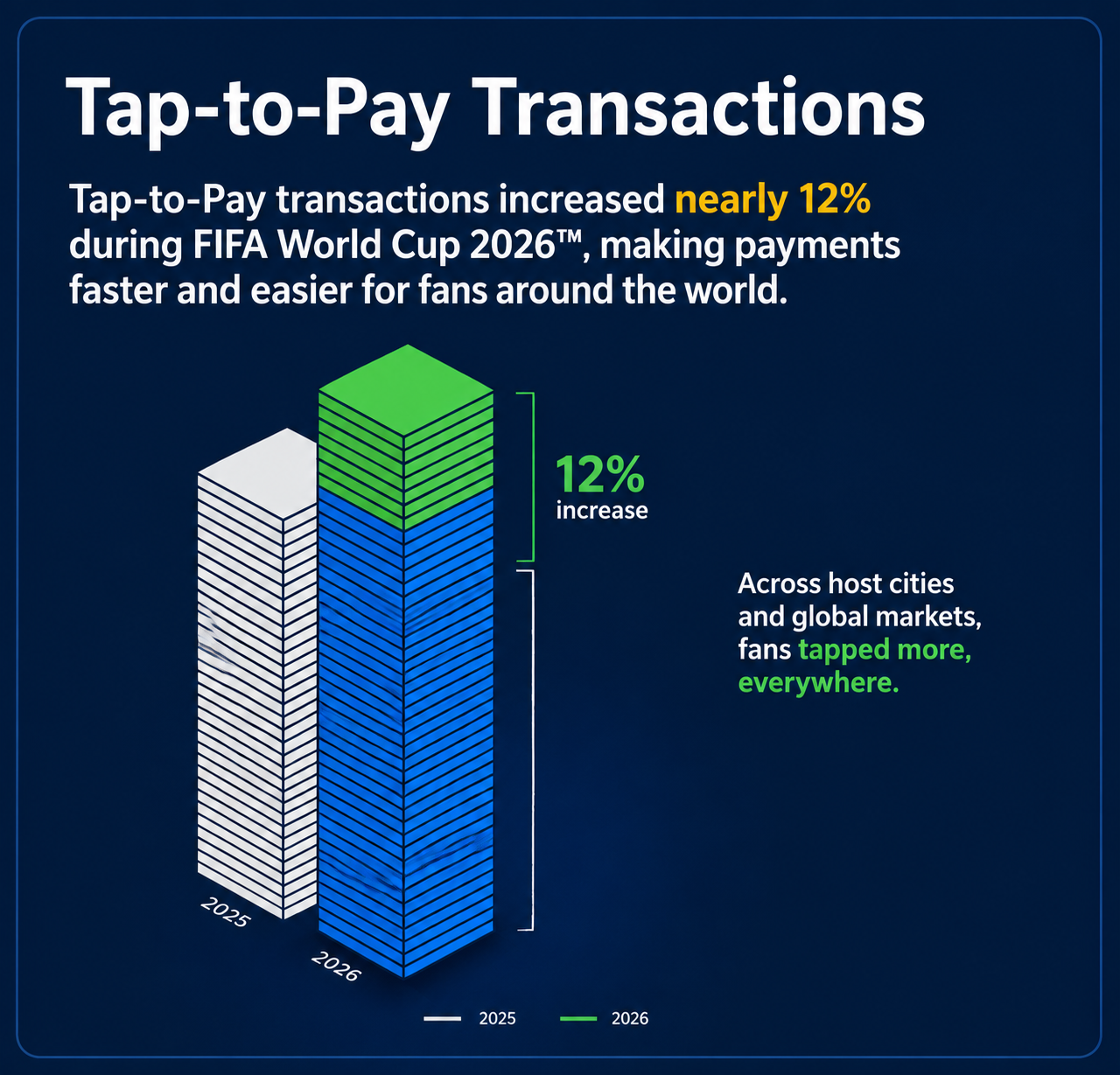
Visa has officially released the numbers behind its FIFA World Cup sponsorship. And they give us plenty to talk about. Across host cities in Canada, Mexico and the United States, cross-border Visa transactions increased nearly 20% year-on-year, while tap-to-pay transactions rose nearly 12%. The data also shows spending moving differently across dining, transportation, entertainment and retail depending on the host city.
Visa describes the phenomenon as the creation of “pop-up economies” around the World Cup. That is an interesting way to look at the tournament because it moves the conversation beyond ticket sales, sponsorship values and broadcast revenues. A global sporting event temporarily changes how money moves through cities, merchants and even countries, and payment networks sit directly in the middle of that activity.
Visa has given us the numbers. So, let’s decode what they tell us about the changing relationship between fintech, finance and sport.
The World Cup created temporary financial ecosystems
The headline number is the nearly 20% year-on-year increase in cross-border Visa transactions across host cities. Fans from Colombia, Puerto Rico, the United Kingdom, Argentina and Brazil were among the biggest sources of international spending, while Santa Clara/San Jose, Boston and Miami recorded some of the strongest increases in overall in-person spending.
The impact was not concentrated in one type of purchase either. Visa’s data shows how different parts of the local economy benefited as fans moved through host cities:
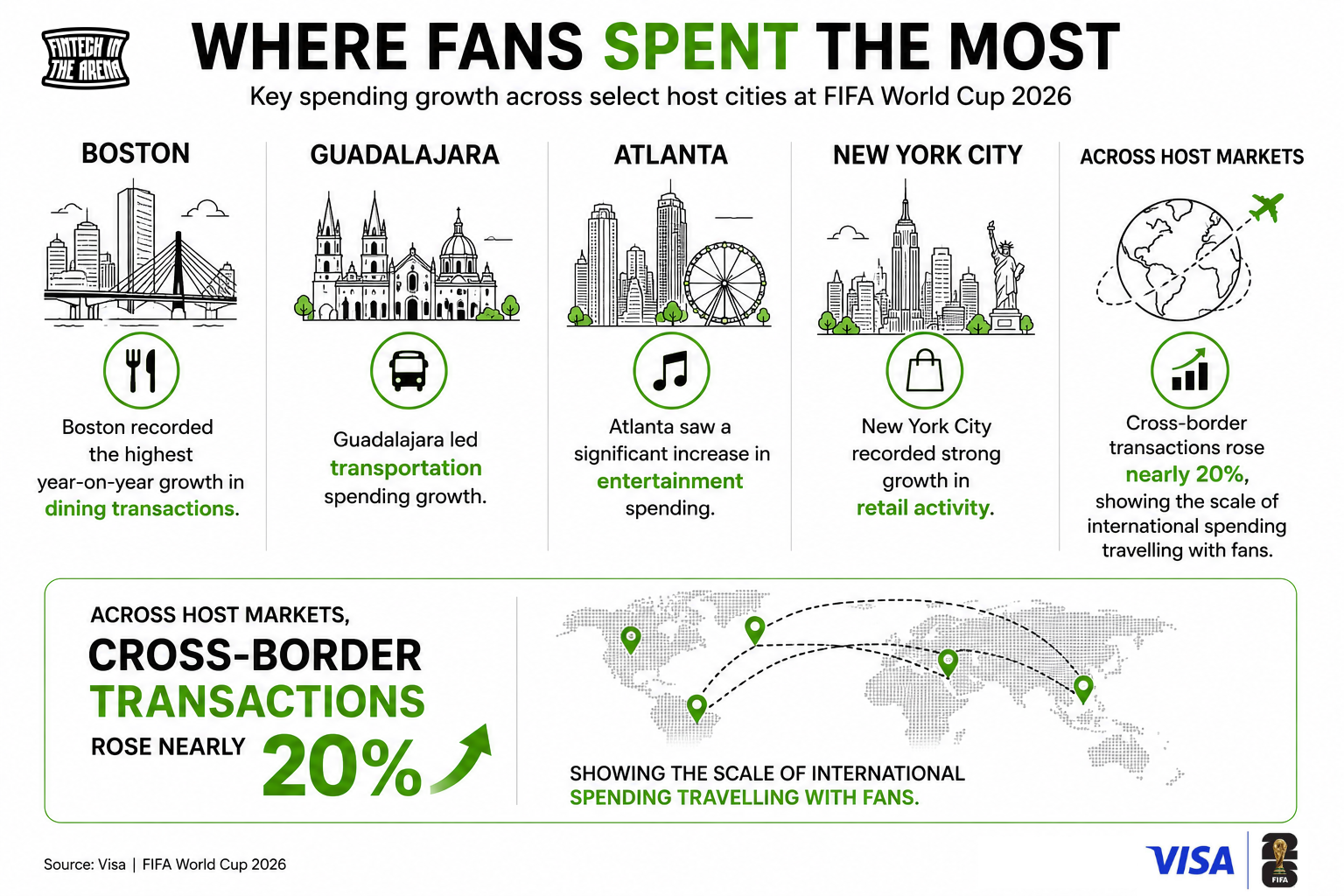
This is where the idea of the World Cup as a temporary financial ecosystem becomes useful. A match creates demand far beyond the stadium. Travelling supporters need accommodation, transport and food; they visit bars and restaurants, buy merchandise, shop and spend on entertainment. Each match effectively creates a temporary concentration of economic activity around the people following it.
Sports finance has traditionally been easier to measure through assets directly attached to the game: tickets sold, sponsorship contracts signed, broadcasting rights negotiated or merchandise purchased. Payments data exposes another layer: the economic activity that happens because the game exists.
A 12% rise in tap-to-pay tells another story
Visa also reported that tap-to-pay transactions increased nearly 12% during the tournament. On its own, that might look like another consumer payments statistic. In the context of a World Cup spanning three countries and attracting millions of domestic and international fans, it says something more about the financial infrastructure required to support modern sporting events.
A global tournament brings together consumers with different cards, currencies, banks and payment habits. At the same time, restaurants, transport providers, retailers and entertainment businesses experience sudden increases in demand. Payments have to remain fast and familiar despite that complexity.
Underneath a fan tapping a card or phone sits an entire fintech stack: merchant acquiring, card networks, foreign exchange, authentication, fraud detection and payment acceptance infrastructure. Most fans will never think about any of it, which is precisely the point. The infrastructure becomes valuable when the complexity disappears from the consumer experience.
Norway shows that the fan economy does not stop at the host city
Perhaps the most interesting part of Visa’s data comes from somewhere outside North America.
During Norway’s World Cup run, Visa transaction volumes in Norway nearly doubled during matches. As the national team progressed further into the competition, Visa observed increased transaction activity across an expanding number of markets. By later matches, spending increases were visible across more than 60 countries.
Visa measured this by comparing transaction activity during the 12 hours surrounding matches with comparable days and times before the tournament, looking across categories including restaurants, bars and cafés, entertainment, retail and grocery.
The implication is significant for sports finance. The economic footprint of a match is not limited to the city hosting it. Fans watching thousands of kilometres away can create their own smaller matchday economies through gatherings, dining, entertainment and retail spending.
A sporting result can therefore change economic behaviour far beyond the stadium in which it happens.
For teams, leagues and sponsors, this gives another dimension to the idea of fan value. Television audiences tell us how many people watched. Social engagement tells us how audiences interacted online. Ticketing tells us who entered the venue. Payments data can provide another signal: what fans did economically when their attention was highest.
Payments data could become another layer of sports intelligence
This is where Visa’s World Cup numbers become particularly interesting for the future of Sports × Fintech.
Sports organisations already collect large amounts of first-party data through ticketing platforms, memberships, apps, loyalty programmes, merchandise stores and digital content. Sponsors supplement that with audience measurement, brand exposure and engagement data. Payment companies occupy a different position because they can observe economic activity surrounding the sporting event itself.
The World Cup data demonstrates the kinds of questions that transaction information can begin to answer:
- Which host cities captured the greatest increase in international spending?
- Which merchant categories benefited when fans arrived?
- Where did travelling fans come from?
- How did spending behaviour change around individual fixtures?
- Did a team progressing further into a tournament create measurable economic activity elsewhere?
- How far beyond the host city did the financial impact of a sporting moment travel?
Visa even identified individual fixtures associated with particularly strong spending increases. Matches including Ecuador vs Curaçao, Colombia vs Ghana and Croatia vs Ghana were among those generating the highest year-on-year spending uplift around kick-off in Kansas City and Philadelphia.

That creates interesting possibilities for the wider sports industry. Host cities can better understand where event-driven spending lands. Merchants can identify the categories and periods where demand increases. Rights holders can build a more detailed picture of the economic footprint created by their competitions.
For sponsors, the opportunity is particularly interesting. Sponsorship measurement still relies heavily on metrics such as reach, impressions, media exposure and engagement. Transaction data introduces the possibility of adding economic behaviour to that picture, especially for financial companies already sitting inside the payment flow.
Fintech’s role in sport is getting bigger than sponsorship
The broader direction is worth watching.
The relationship between financial companies and sport has traditionally been highly visible through sponsorship: banks on shirts, payment companies becoming official partners, cardholder presales, branded fan experiences and hospitality packages. Those relationships are still important, but Visa’s World Cup data points towards a deeper role for financial technology.
Fintech infrastructure can facilitate the economic activity surrounding sport, while the transactions flowing through that infrastructure can help explain how that economic activity behaves.
That matters as the sports industry becomes more interested in understanding fans beyond audience size. A supporter has value as a viewer, ticket buyer and merchandise customer, but their economic activity around sport can extend much further: travel, accommodation, restaurants, transport, entertainment and retail all become part of the wider fan economy.
The World Cup provides an unusually large example of this effect, but the principle can extend to other global tournaments, leagues and major sporting events. Visa called them pop-up economies. For sports finance, perhaps the more important point is that we can increasingly see those economies forming.
And once you can see where the money moves, you can start asking much better questions about what sport is economically worth.
Follow the money behind the game
From payments and sponsorships to deals, partnerships and the changing economics of fandom, FinTech in the Arena tracks where finance and sport collide.
Sign up to get our latest analysis and FinTech × Sports intelligence delivered to your inbox.


Comments ()