How Visa built a global growth engine around the FIFA World Cup
Every fan buying a hot dog at the World Cup taps a Visa card, whether they notice it or not. Two decades of FIFA sponsorship turned a logo deal into a payment monopoly. This breaks down exactly how Visa built it, pillar by pillar >>
Every fan buying a hot dog at the World Cup taps a Visa card, whether they notice it or not. Two decades of FIFA sponsorship turned a logo deal into a payment monopoly.
This breaks down exactly how Visa built it, pillar by pillar >>
Most FIFA sponsors buy a logo. Visa builds a rail.
That distinction matters more than it sounds. Nearly two decades into its run as a Tier 1 FIFA Partner, Visa has converted what most brands treat as a visibility contract into something closer to operational control. The World Cup becomes, for six weeks, a live environment where Visa proves its infrastructure works at a scale almost nothing else can replicate. Studying Visa's approach is less about admiring a big sponsorship budget and more about understanding how a payments brand turns a global tournament into a functioning distribution channel.
The Four Pillars at a Glance
1. Visa owns the Checkout
Inside official tournament zones, every purchase - food, drinks, merchandise - runs through a Visa card or cash. Every other payment network gets locked out of the footprint entirely. This isn't a minor perk buried in the sponsorship contract. It is the centrepiece of the entire deal.
- Exclusive payment rights: Visa is the only card network accepted across official FIFA stadiums and fan zones.
- A temporary economy: Andrea Fairchild, Senior Vice President of Global Sponsorship Strategy at Visa, coined the FIFA World Cup a "39-day pop-up economy" to describe the tournament's unique environment. It is a highly localized, short-term economic explosion of travel, merchandise, and retail.
- A live proving ground: tens of thousands of transactions running through Visa's rails in a matter of weeks, concentrated in a handful of cities, under conditions no ordinary retail environment produces
- Long-term value: Live behavioural data on how fans tap, when they tap, and how fast the system holds up, reused in enterprise pitches to banks and merchants for years afterwards.
2. Visa Extends FIFA Through Its Issuer Network
Visa doesn't activate the FIFA World Cup alone. Instead, it gives participating issuers and financial institutions the ability to run localized promotions using its tournament rights, extending the campaign far beyond Visa's own advertising.
- Participating issuers: Visa's Tap In to Score promotion is available through eligible Visa cards issued by participating financial institutions across multiple markets, including the U.S., Canada, and Mexico.
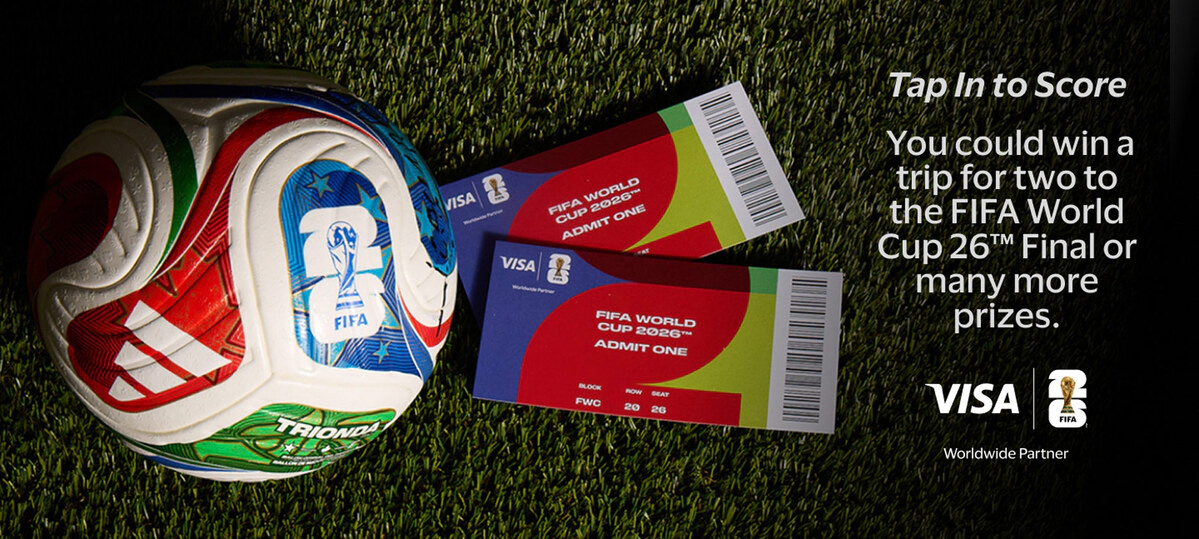
- Activation model: Cardholders register an eligible Visa card, while participating issuers promote the campaign through their own customer channels.
- Rewards: Depending on the market, prizes include FIFA World Cup tickets, trips to the Final, signed memorabilia, and exclusive merchandise.
- Business outcome: Visa supplies the global sponsorship and promotional framework, while issuers contribute customer relationships and distribution. Together, they turn one global campaign into hundreds of localized activations.
Visa applies the same playbook across fintechs, remittance platforms, digital wallets, corporate card providers, and merchant acquirers - allowing partners to build their own FIFA campaigns on top of Visa's tournament rights. We broke down that ecosystem here → How Fintechs From Oman to Canada Are Riding Visa's FIFA Rights.
3. Culture Campaigns Keep the Brand Emotionally Load-Bearing
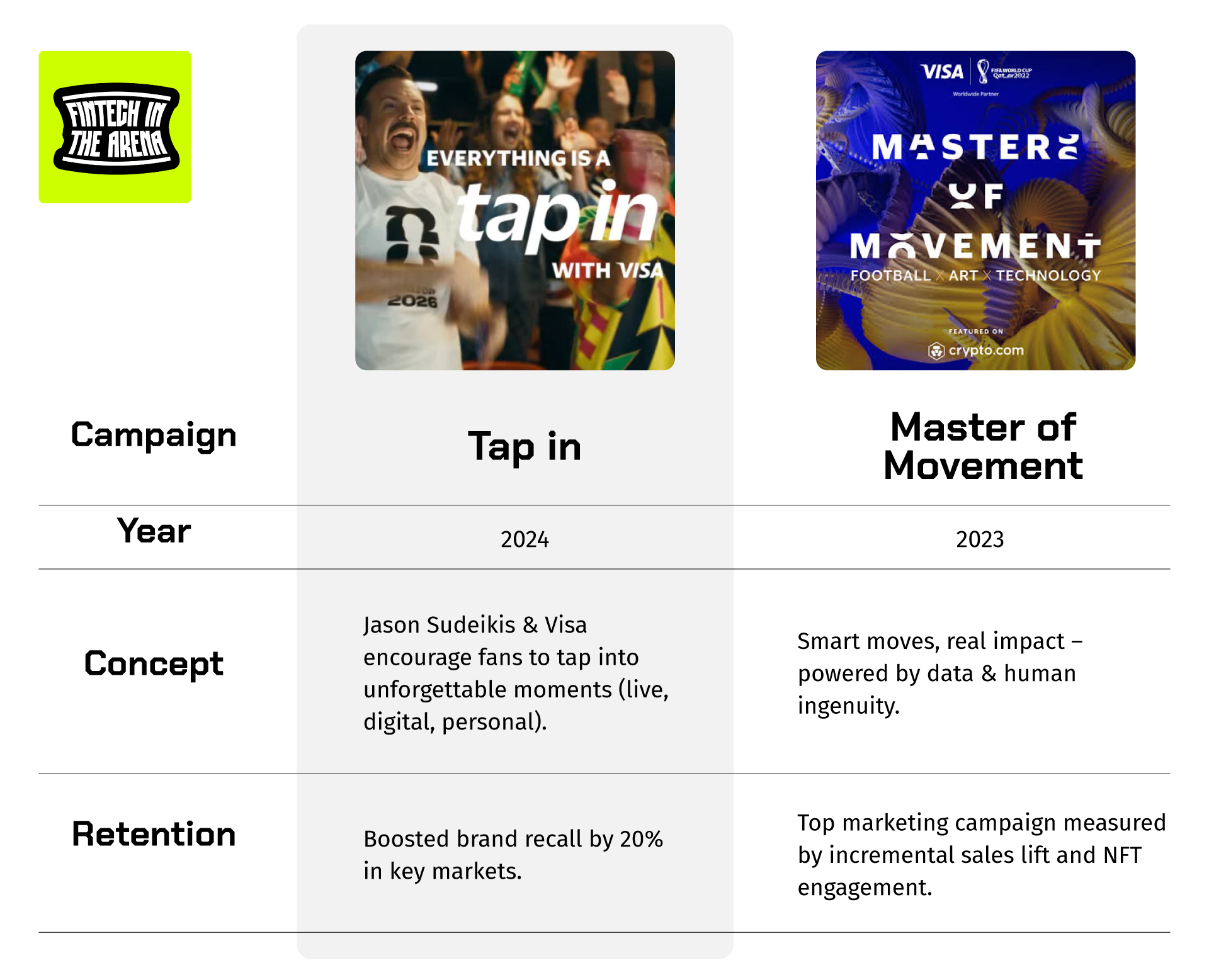
This side of the strategy leans branding, and that balance is intentional rather than accidental. The "Tap In" campaign takes one of the simplest, most universally understood moments in football, a striker poking the ball over the line from close range, and uses it as a stand-in for the ease of tapping a card. It asks for almost no explanation, which is exactly the point.
"Masters of Movement" did something similar for the prior cycle, but leaned experiential rather than broadcast. Fans physically interacted with Visa's technology, and the reward was a piece of personalized digital art minted straight into their own wallet. Both campaigns exist to build emotional stickiness around the Visa name, so the operational exclusivity underneath never feels transactional or cold to the fan standing in line for a hot dog. Distribution earns the trust. Culture keeps the affection.
4. Purpose-Driven Programs Extend the Story Past the Final Whistle
- Program: "Tap In to Impact"
- Funding: $600,000 directed to small-business nonprofits in host markets
- Recipients: SCORE in the United States, Pro Mujer in Mexico
- Focus: supporting local entrepreneurs and small business owners during the tournament cycle
This is the softest layer of the strategy, and closer to branding than distribution. It doesn't move transaction volume or lock out competitors. What it does is give Visa a community-facing story that outlasts the tournament news cycle and travels well in markets where payment infrastructure headlines simply don't land the same way as a local funding announcement does. It rounds out the sponsorship so Visa's presence reads as more than a commercial land grab dressed up in football colors.
How the Four Pillars Work Together
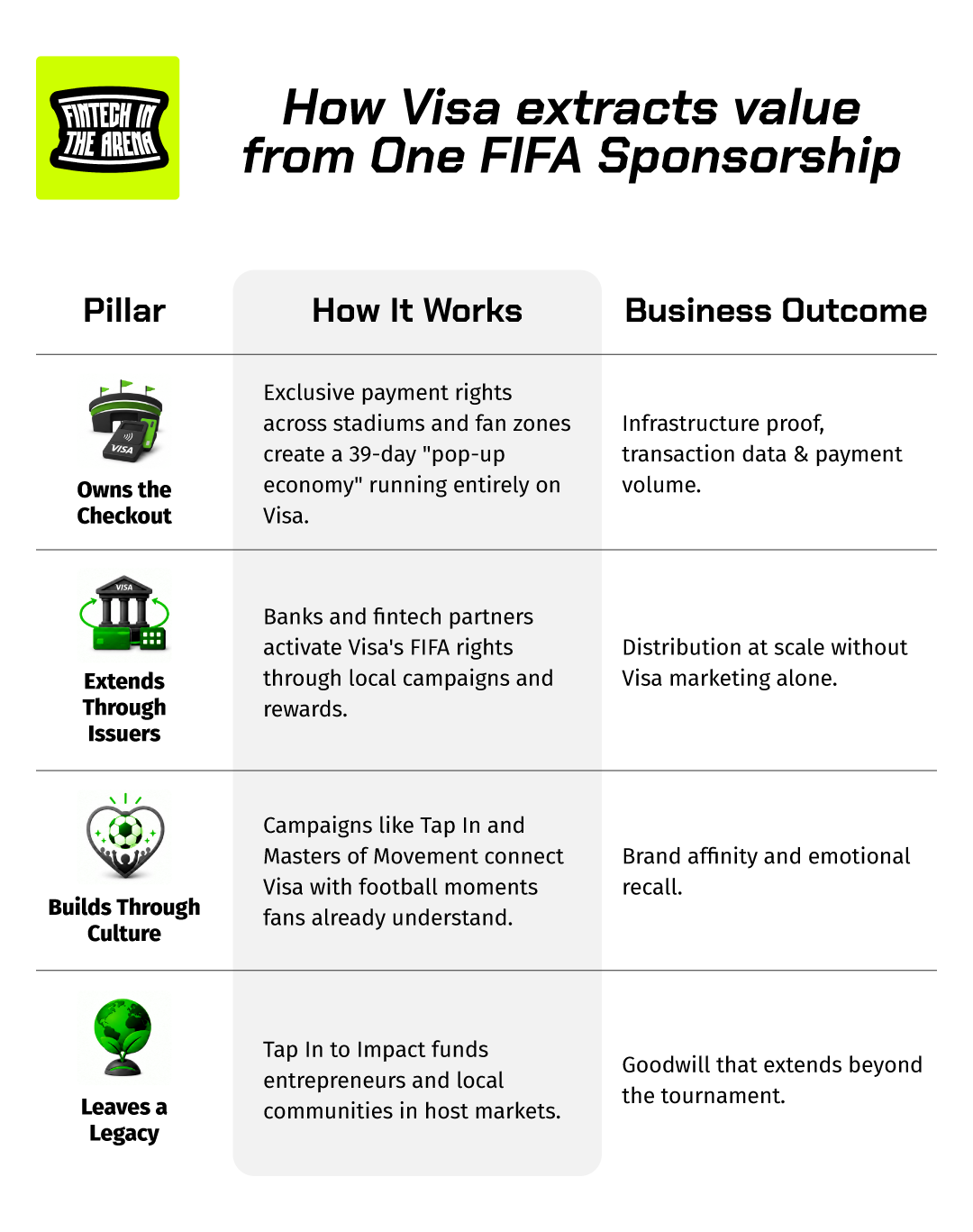
None of these four pillars work particularly well in isolation. Exclusivity without culture reads as corporate gatekeeping. Culture without exclusivity is just another ad campaign. Together, they let Visa run one of the most complete sponsorship playbooks in sports business, one that treats the tournament as infrastructure to prove, not just a stage to be seen on.
The Angle Worth Sitting With
Twenty years of FIFA sponsorship let Visa move from buying attention to owning the plumbing fans transact through, then wrapping that plumbing in enough culture and community work that it never reads as cold infrastructure. Most sponsors are still deciding whether they want a logo on a shirt. Visa decided years ago that the shirt was never the asset worth owning. The stadium's payment rail was.
If you want the same analytical lens applied to the full Fintech x Sport deal landscape - beyond the World Cup and across the year - Marcel van Oost's newsletter Connecting the Dots in FinTech has tracked this intersection for eight years.
Comments ()