FinTech X Women's Sports 2
Financial brands are showing up across women’s sports. But how deep does that relationship go? We map the payments, products and infrastructure emerging behind the sponsorships.
How Fintech Is Moving Beyond the Jersey in Women’s Sports
Part 1 followed the financial brands putting their names behind women’s sports. Part 2 looks beyond the visible sponsorships, mapping the payments, financial services and infrastructure emerging around the game, and how much of that opportunity remains open.
In Part 1, we followed the visible money. Ally built a portfolio across basketball, golf and esports, Revolut and Starling moved into women’s football, while Fawry, DBS and M-PESA found opportunities through athletes and developing sporting properties. Across those deals, fintech was buying something increasingly valuable: an association with a growing sports audience.
 Marcel
There was another set of deals that deserved a closer look. Nium entered global cricket as the ICC’s first Official Fintech Infrastructure Partner way back in 2021. India’s Women’s Premier League has attracted BHIM UPI, SBI, Tata Capital and Policybazaar around its media ecosystem. Mastercard has expanded its women’s sports portfolio through properties including the Billie Jean King Cup. Zodia Markets has taken a digital-assets brand into grassroots women’s cricket.
They are very different relationships, and that difference is important. Some remain sponsorship and media plays. Some bring financial products closer to fans. A much smaller group sits closer to the infrastructure underneath the sport.
So, for Part 2, we went looking behind the sponsor board.
Women’s cricket has become a magnet for financial services
Cricket gives us one of the clearest places to see the financial-services mix expanding.
Nium entered the ICC ecosystem in 2021 through a multi-year agreement as its Official Fintech Infrastructure Partner. The company specialises in B2B payments infrastructure, including cross-border payments and card issuance, and the ICC relationship gave it a platform across the governing body’s global tournament portfolio. Nium subsequently extended its involvement into the ICC Women’s Cricket World Cup.
That makes Nium particularly interesting for this deep dive, although the terminology needs some care. Its status as a fintech infrastructure company does not mean Nium processes every payment occurring at an ICC event. The partnership itself includes familiar sponsorship components such as brand exposure and activations. What changes is the type of company entering the sports ecosystem: a B2B fintech whose proposition is built around moving money internationally is using a global sports property to reach businesses and decision-makers.
India’s WPL presents another version of the trend. For the 2026 season, JioStar secured 15 sponsors around its coverage, including SBI, BHIM UPI, Tata Capital and Policybazaar. JioStar specifically highlighted the growing presence of BFSI, fintech and payments among the categories attracted to the league.
Put those names together and women’s cricket starts attracting a surprisingly broad slice of finance.
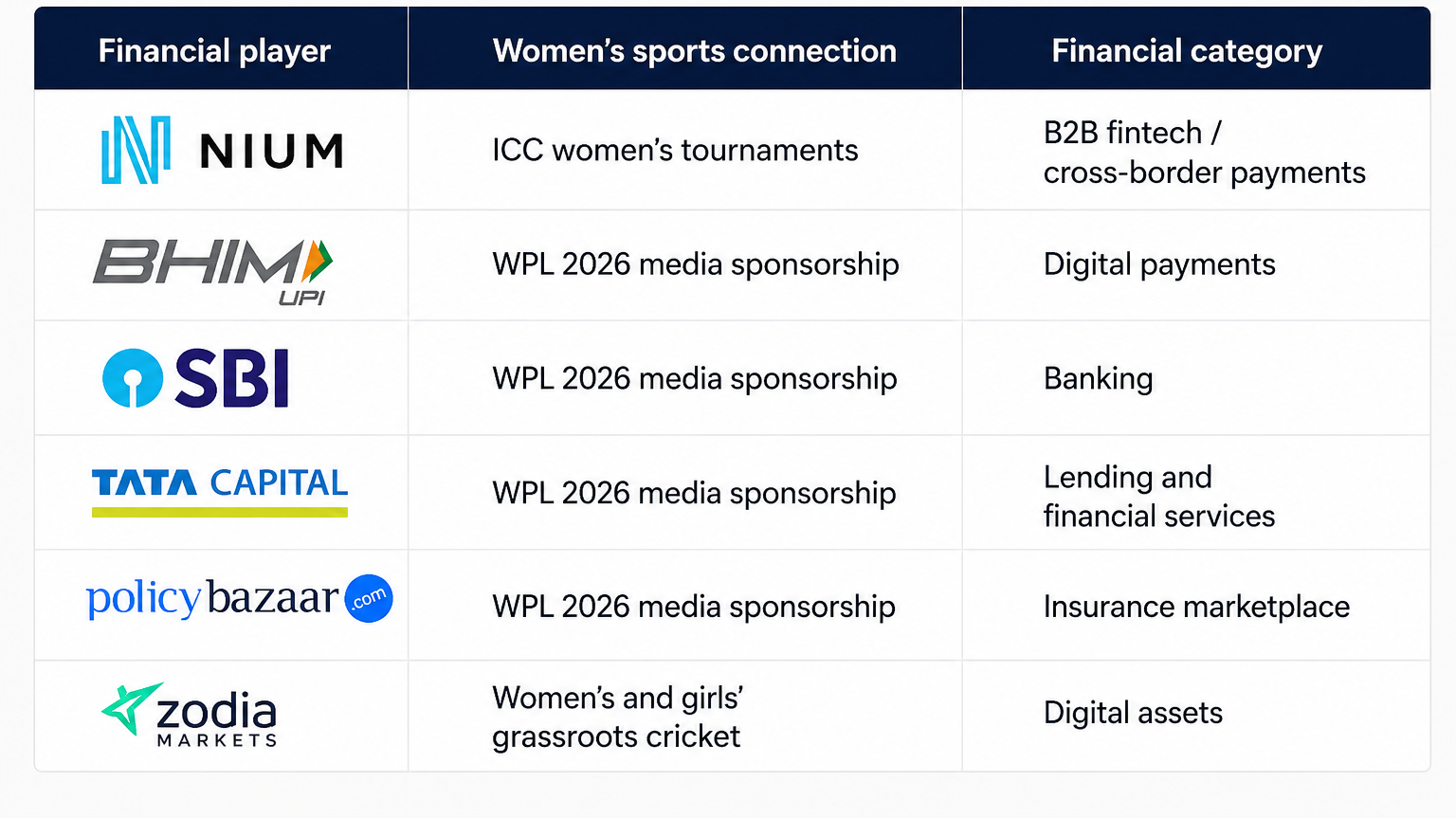
One name here will be familiar from Part 1.
We previously included Zodia Markets among the financial brands investing in the wider women’s sports ecosystem. In 2025, the institutional digital-assets platform launched its Cricket for Her initiative and began a three-year sponsorship of the women’s and girls’ teams at St Peter’s Cricket Club in Brighton, supporting the women’s first XI, softball and junior girls’ teams.
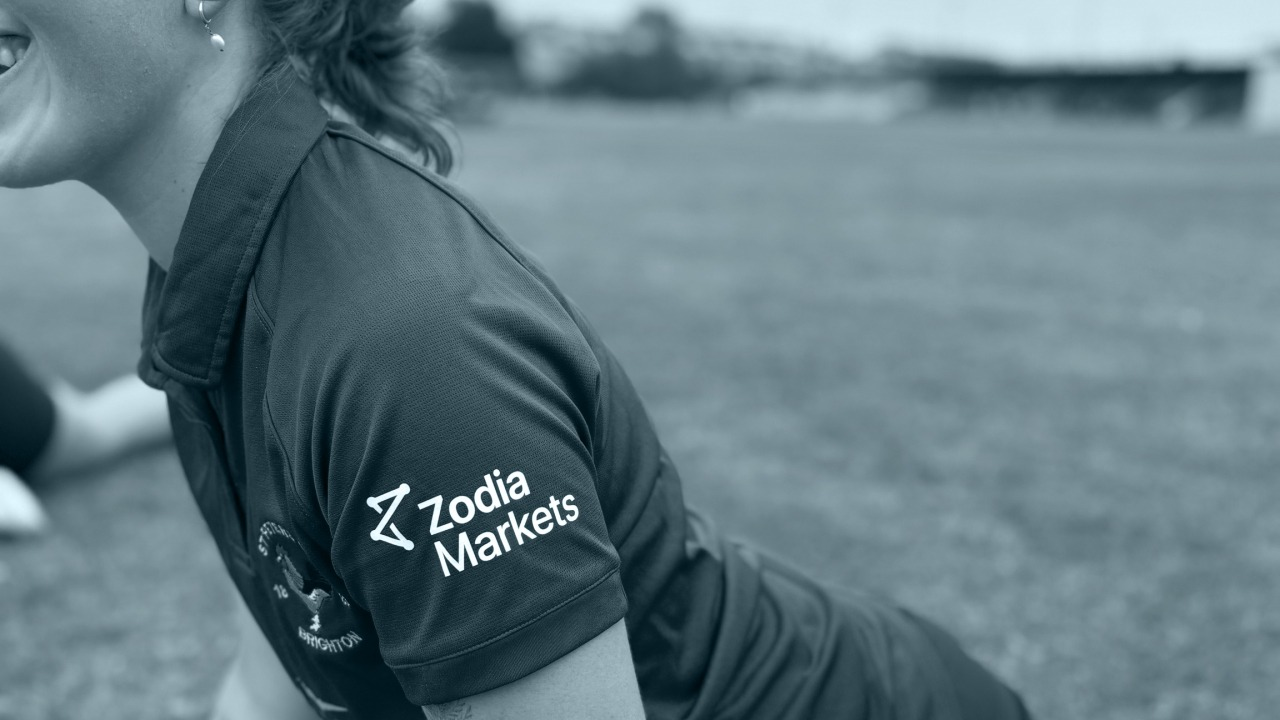
It earns another mention here for a different reason. Zodia sits closer to the ecosystem-investment side than the infrastructure layer we are exploring in Part 2, but alongside Nium, BHIM, SBI, Tata Capital and Policybazaar, it helps show just how broad the financial-services presence around women’s cricket has become. Banking, digital payments, lending, insurance, cross-border fintech and digital assets are all finding their own entry points into the sport.
One sport, several corners of the financial-services industry.
There is also a geographic logic to this. The WPL operates in India, one of the world’s largest digital-payments markets, while ICC tournaments move teams, businesses and fans across borders. As women’s cricket becomes more commercially valuable, its financial ecosystem becomes more valuable too.
The next question is how far financial brands can move inside it.
Payments have the clearest route beyond visibility
Payments companies have always had a natural relationship with sport. Fans buy tickets, merchandise, food and subscriptions; they travel to matches and increasingly follow teams across borders. A payments company therefore has plenty of reasons to value a sports audience before any technology is integrated into the property itself.
Mastercard shows how broad that strategy can become.
In June 2025, Mastercard became a global partner of the Billie Jean King Cup, the women’s World Cup of Tennis. Alongside conventional sponsorship exposure, the partnership gives Mastercard cardholders access to Priceless Experiences and makes the company the inaugural partner of the competition’s Global Rankings and Team of the Year award. The tournament had a record 146 nations entering in 2025, giving Mastercard an international property that sits comfortably alongside its existing tennis portfolio.
The company has also been experimenting with commerce around women’s sports away from the court. In 2025, Mastercard backed SOOO, a women’s sports retail concept on Regent Street in London showcasing independent brands and products connected to women’s sport. Mastercard provided funding as well as marketing and promotional support.
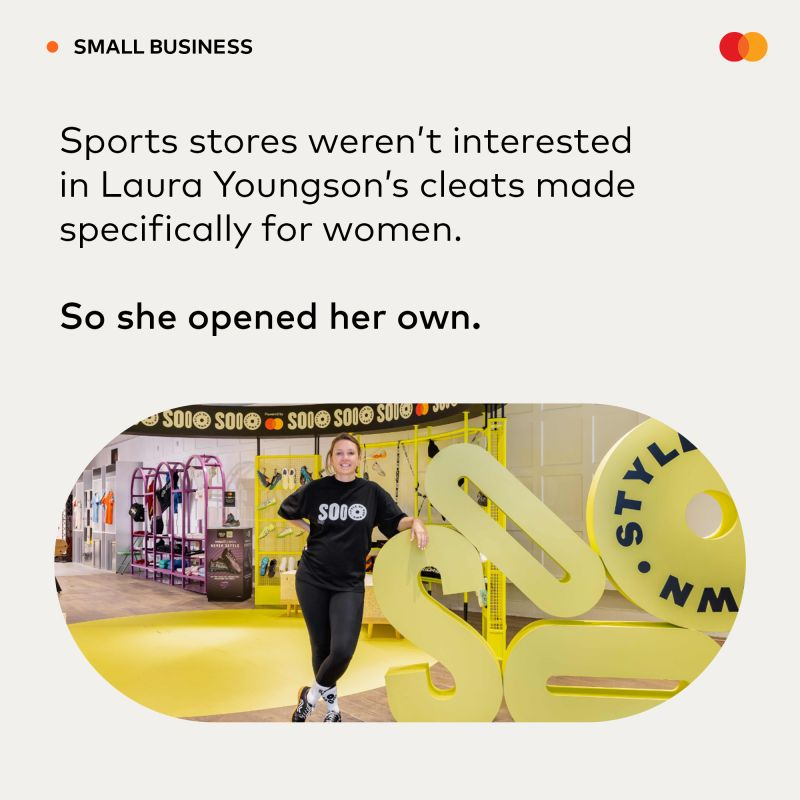
These remain primarily sponsorship, experiences and commerce initiatives rather than examples of Mastercard becoming the underlying payment rail for an entire competition. That distinction is useful.
A payments logo and a payments integration can sit very close together while doing very different jobs.
BHIM UPI appearing around WPL coverage gives the payment brand exposure. Mastercard offering experiences to its cardholders connects sponsorship to an existing financial product. Nium’s B2B proposition sits closer to financial infrastructure.
That gives us a rough spectrum:
Brand exposure → customer benefit → product usage → financial infrastructure
Most of the women’s sports deals we found still sit towards the first half.
And that may be the most revealing finding in Part 2.
Financial services are widening faster than financial integration
The variety of companies entering women’s sports is already striking. Payments companies are present. Banks are present. Insurance and lending platforms are present. Asset managers appeared throughout Part 1, while digital-assets companies are beginning to appear at grassroots level.
What we found far less often were examples where those financial services had become deeply embedded into how a women’s team, league or tournament operates.
BHIM’s presence around WPL coverage should not be interpreted as BHIM operating the league’s payment infrastructure. Policybazaar’s sponsorship does not mean insurance has been embedded throughout the WPL fan journey. The same caution applies to banking and payments partnerships elsewhere.
That sounds like a technical distinction, but commercially it is a big one.
A financial company can derive considerable value from media exposure without ever providing the underlying financial service. Moving deeper means finding a place where the company’s product becomes useful to the team, league, athlete or fan.
How deep can fintech eventually go?
There is an advantage to women’s sports reaching this stage of commercial growth now. Many leagues and properties are expanding their commercial operations during an era of digital wallets, instant payments, embedded finance, modern payment APIs and direct-to-consumer commerce.
That gives them a different toolkit from sporting properties whose commercial systems were assembled over several decades.
A women's team building its membership programme today can start with digital recurring payments. A tournament with an international audience can think about cross-border commerce from the beginning. Merchandise can be sold directly to supporters across markets, while loyalty can be attached to cards, wallets or payment products.
There are several areas worth watching as the market develops:
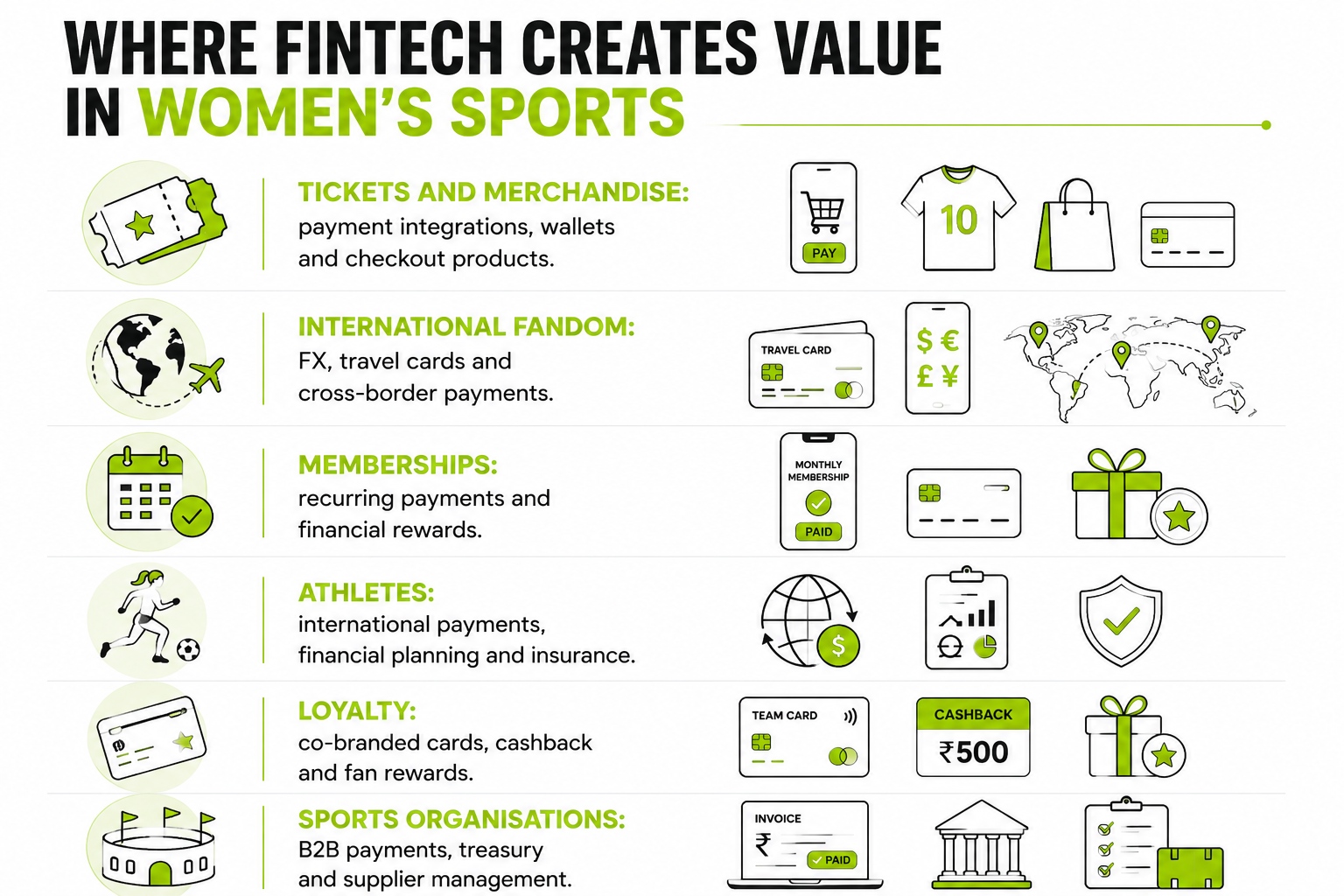
The point is not that fintech will necessarily capture every one of these layers. Banks, card networks, payment processors and other technology providers will compete for the same opportunities.
But women’s sports are building audiences and commercial systems at the same time. That makes the financial layer particularly interesting to watch.
The financial stack is still being built
Across this two-part series, the fintech opportunity in women’s sports starts to look like three connected layers.
Branding
Sponsorship → media → athletes → grassroots
Distribution
Experiences → merchandise → memberships → financial products
Infrastructure
Payments → banking → insurance → cross-border money movement
- The first layer is already busy. Part 1 found financial brands across football, basketball, tennis, golf, badminton, cricket and esports, with some building entire portfolios around women’s sports.
- The second is beginning to take shape. Mastercard is connecting sports partnerships to cardholder experiences and commerce; financial brands around the WPL are getting closer to one of the fastest-growing women’s sports audiences; payments companies have products that naturally extend into the transactions surrounding fandom.
- The third layer remains thinner. Nium gives us one useful signal from B2B fintech, but our research found considerably fewer examples of financial companies becoming deeply embedded in the operational infrastructure of women’s sports.
There is plenty left to build.
Better payments, easier international commerce and stronger fan relationships could help women’s sports turn growing attention into sustainable revenue. Financial brands are already here; the next phase is seeing how many go beyond the jersey.
Want more on where fintech and sports are heading next? Sign up for FinTech in the Arena and get our latest deep dives straight to your inbox.

Comments ()