Fintech X Basketball: What are financial brands really buying?
From jersey patches and arena naming rights to co-branded payment cards and product launches, financial companies are using basketball in increasingly different ways. We map the partnerships shaping the category and explore what these companies are really buying beyond visibility.
From jersey patches and arena naming rights to co-branded payment cards and product launches, financial companies are using basketball in increasingly different ways. We map the partnerships shaping the category and explore what these companies are really buying beyond visibility.
Financial brands are becoming difficult to miss across basketball courts worldwide.
Albert sits on the Los Angeles Lakers jersey. Robinhood holds patches across the Miami Heat, Memphis Grizzlies, and Washington Wizards. Sezzle represents the Minnesota Timberwolves, Ledger champions the San Antonio Spurs, while JPMorganChase took over the Dallas Mavericks patch previously held by Chime.
The activity stretches well beyond jerseys. SoFi operates at the league level. Crypto.com put its name on the Lakers' home arena. American Express has built its NBA relationship around cardmember access and experiences. Revolut went one step further by taking NBA intellectual property directly into its core financial products.
When you analyze these deals together, two distinct strategies emerge: branding and distribution.
Some financial companies use basketball to build familiarity, strengthen their market positioning, or establish a physical presence around an otherwise purely digital brand. Others connect sponsorship rights directly to cards, accounts, payments, and customer acquisition funnels.
1. The Fintech Footprint Across Basketball (With Deal Timelines)
The jersey patch remains the most visible piece of sports real estate, and financial companies now occupy several across the NBA.
Current & Recent Team-Level Partnerships
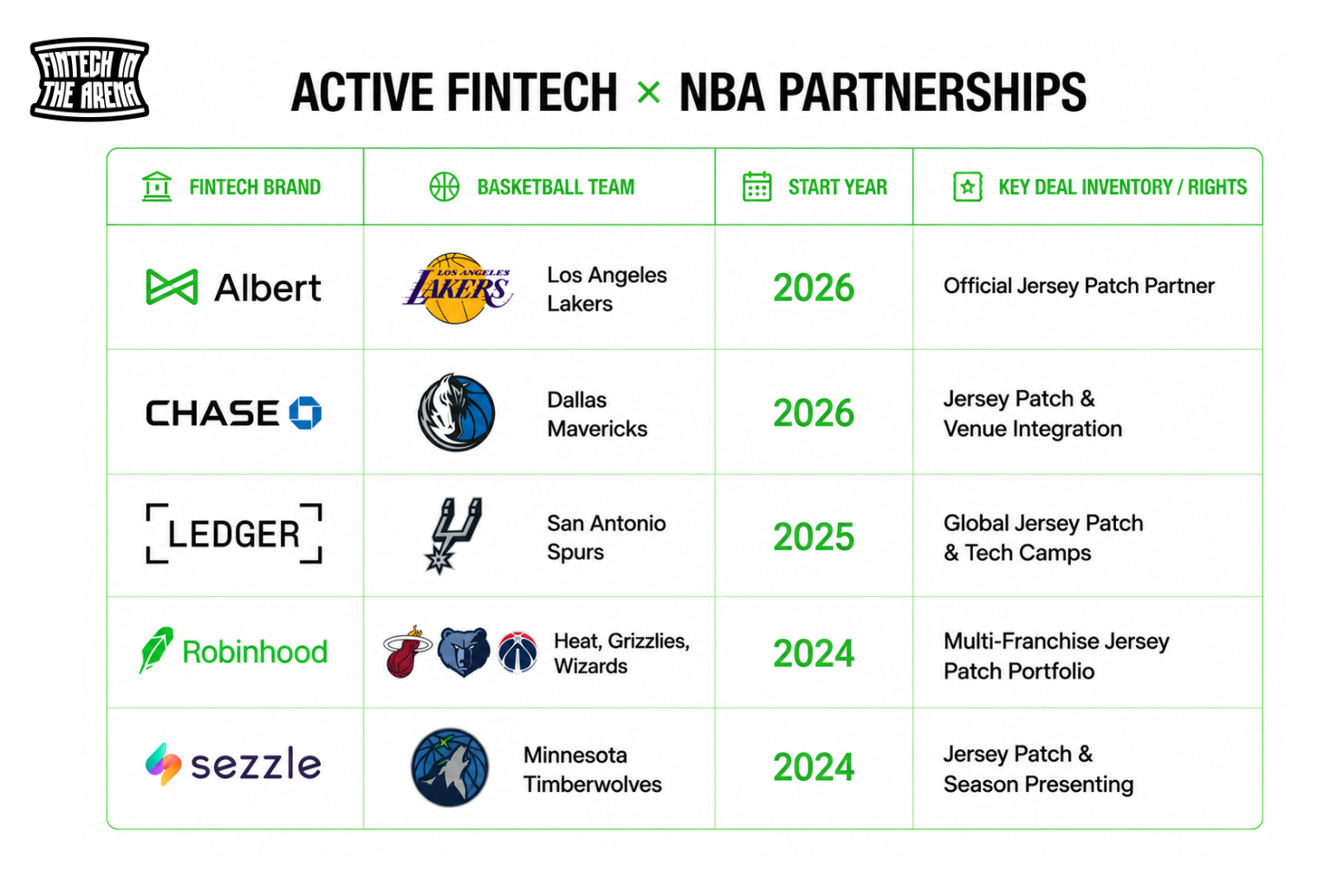
- Albert X Los Angeles Lakers (Signed July 2026): Personal finance app Albert secured a multi-year deal as the Lakers' jersey patch partner, replacing South Korean food brand Bibigo.
- JPMorganChase X Dallas Mavericks (2026): Chase expanded its basketball footprint by taking over the Mavericks' jersey patch in 2026 following Chime's previous multi-year run with the team.
- Ledger X San Antonio Spurs (Signed June 2025): The Paris-based crypto security and hardware wallet company replaced Self Financial as the Spurs' official jersey patch partner.
- Robinhood X Miami Heat, Memphis Grizzlies & Washington Wizards (2024): Robinhood built a multi-market NBA presence by securing jersey patch deals across three distinct regional franchises in late 2024.
- Sezzle X Minnesota Timberwolves (Signed August 2024): Minneapolis-based Buy-Now-Pay-Later (BNPL) provider Sezzle inked a multi-year deal as the official jersey patch and presenting partner.
League-Wide, Arena & International Deals
- SoFi (2024): Signed a multi-year agreement as the official banking partner of the NBA, NBA G League, NBA 2K League, and USA Basketball, along with title entitlement to the SoFi NBA Play-In Tournament.
- Revolut (2024–2025): Partnered with the NBA in Europe around marquee events (e.g., NBA Paris Games) and integrated league IP directly into co-branded consumer cards.
- Ant Group / Alipay+ (2023): Strategic partnership with NBA China to integrate digital payment channels, fan engagement hubs, and Web3 digital collectibles into Alipay.
- eToro (2021): Expanded its European sports sponsorship footprint through court-side digital visibility with Spain's Baskonia and EuroLeague basketball.
- Crypto.com (2021): Secured a 20-year, $700M+ naming rights agreement for Crypto.com Arena in Los Angeles.
- Coinbase (2021): Signed a multi-year league-wide agreement as the exclusive cryptocurrency platform partner of the NBA, WNBA, and G League.
- American Express (Long-Standing / Renewed 2020 & 2024): Combines its league relationship with cardmember ticket presales, court-side experiences, and team-specific perks (Lakers, Nets, Bulls, Jazz).
There is no single basketball asset that financial companies are converging around. They are buying across the ecosystem-from a few square inches of jersey fabric to league entitlement rights, physical arenas, and debit card artwork.
What changes is the job those assets are being asked to perform.
2. Branding: Trust, Positioning, and Product Shifts
Financial services carry an unusually high trust threshold. A customer deciding where to deposit a paycheck, secure digital assets, or hold a retirement portfolio makes a very different decision than buying a beverage or pair of sneakers.
For digital-first fintechs without traditional physical branch networks, basketball provides a physical anchor inside established cultural institutions.
Borrowing Mainstream Familiarity
- Ledger X San Antonio Spurs (2025): By moving onto the Spurs jersey, French hardware wallet maker Ledger placed a crypto-native self-custody brand in front of millions of mainstream viewers. The partnership carried an intentional international angle via Spurs superstar Victor Wembanyama and French market activations during the NBA Paris Games.
- Crypto.com Arena (2021): Putting its name on a major metro arena anchored the brand permanently into sports broadcasts, pop culture, and daily traffic references, insulating it from market volatility.
The Brand Expands as the Product Suite Expands
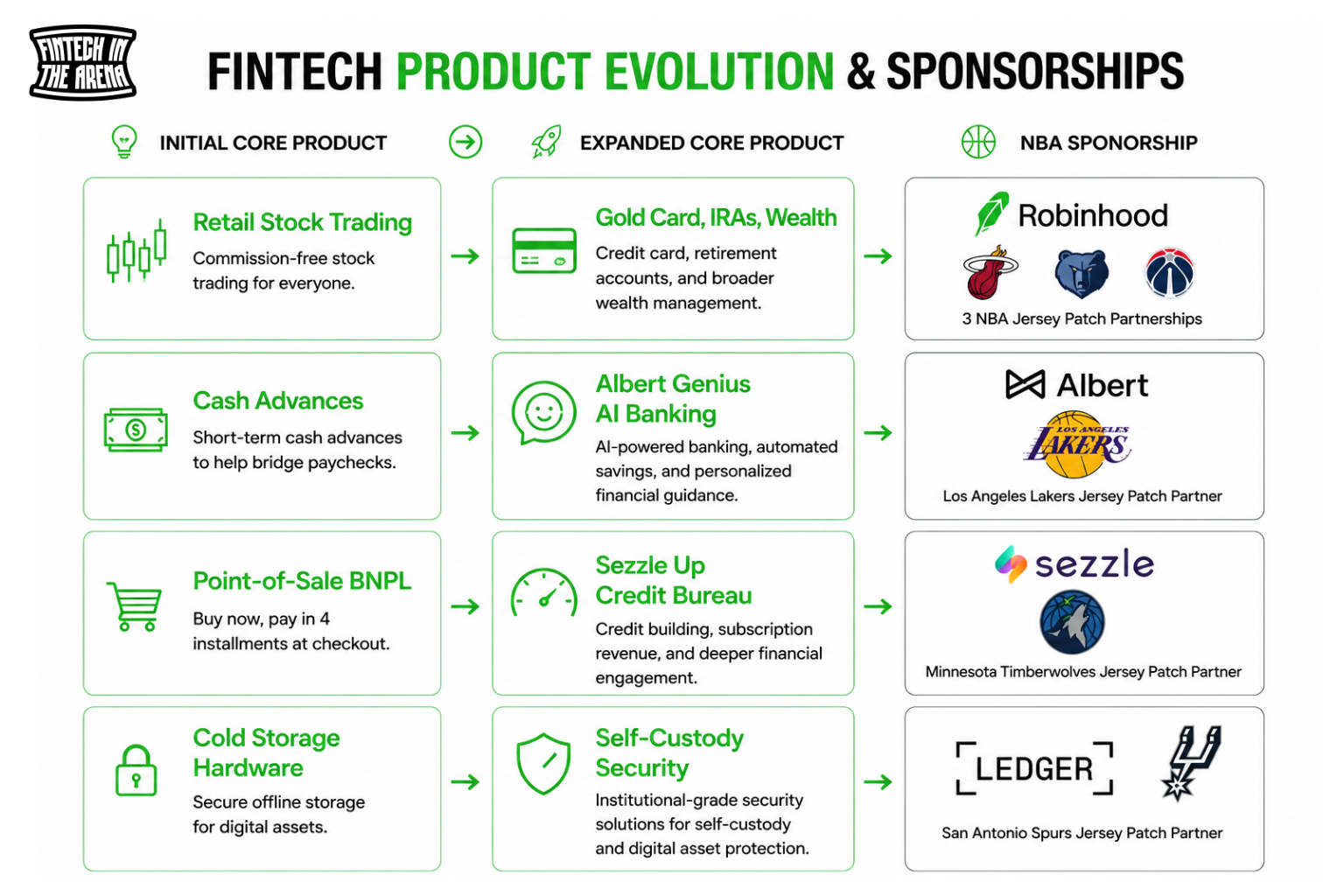
Sponsorship scale often mirrors internal product expansion. As fintechs evolve from single-feature apps into comprehensive financial institutions, their sponsorship needs shift toward broad-reach assets:
- Robinhood (Promoting: Robinhood Gold Card, IRAs & Wealth): Originally known strictly for commission-free stock trading, Robinhood has expanded aggressively into credit cards (Robinhood Gold Card), retirement matching (1%–3% IRA boosts), and automated wealth tools. Holding jersey patches across three NBA markets (Miami, Memphis, Washington) elevates Robinhood from a niche retail trading app into a mainstream wealth platform.
- Albert (Promoting: Albert Genius AI Advisory & Core Deposit Accounts): Albert has expanded beyond basic early paycheck access into automated savings, portfolio management, and AI-driven advisory via Albert Genius. Partnering with the Lakers places this multi-feature banking suite on a global media engine.
- Sezzle (Promoting: Sezzle Up Credit-Building & Premium Subscriptions): To move past standard checkout BNPL, Sezzle introduced Sezzle Up (which reports pay-in-4 history to credit bureaus) and paid subscription tiers. The Timberwolves deal helps promote these long-term credit products directly to younger consumers.
3. Distribution: When Basketball Enters the Product
While branding builds trust, distribution-heavy deals turn sports IP into a direct engine for app downloads, card activations, and transaction volume.
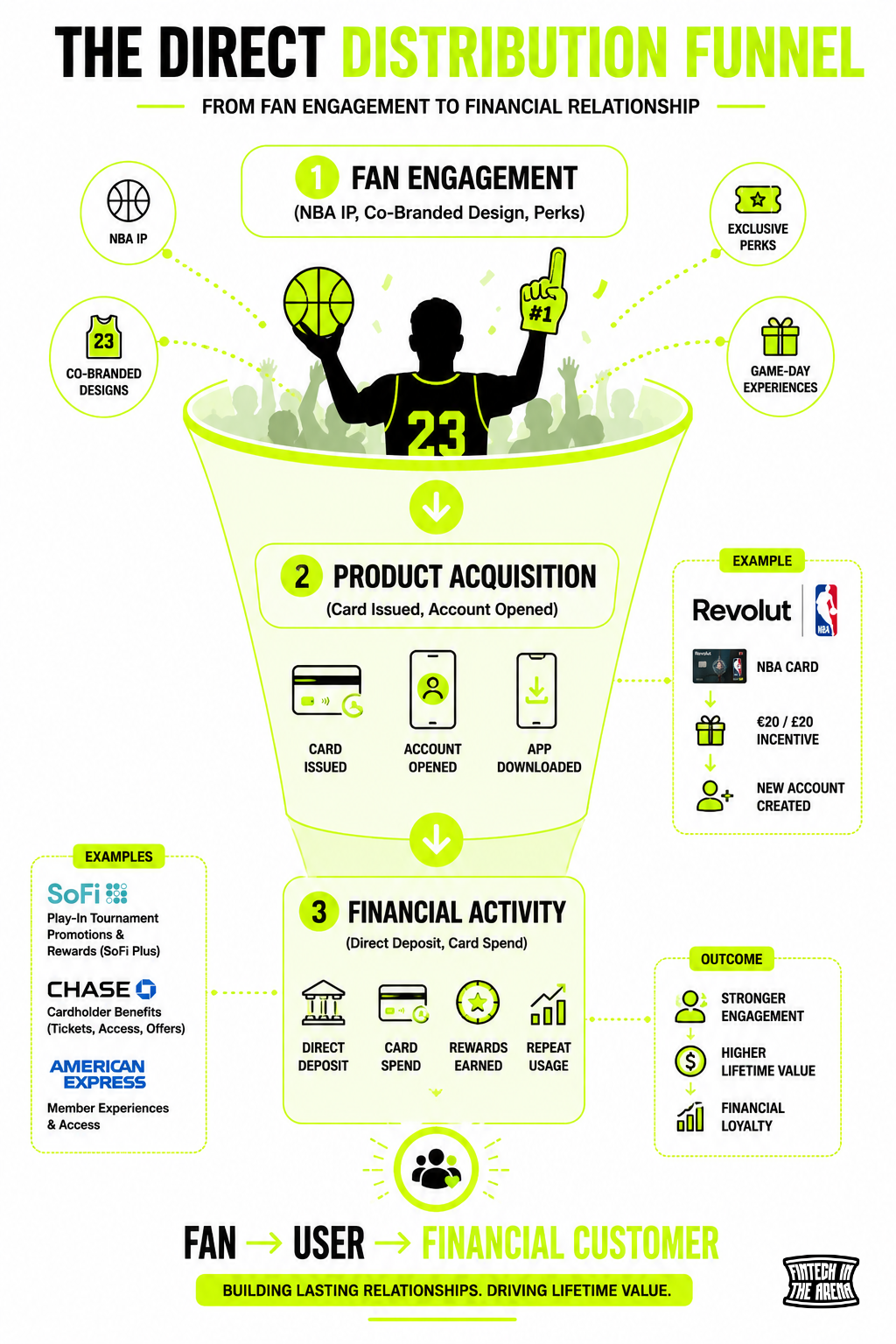
Revolut: Turning Fandom into an Account Funnel
Revolut offers a clear example of basketball rights functioning as product distribution.
- Product Integration: Revolut issued physical, NBA-branded payment cards featuring official court and basketball textures across Europe.
- Acquisition Mechanics: Revolut paired the card launch with direct acquisition offers—such as a €20 cash bonus for new customers who opened an account, chose an NBA card, and completed initial transactions.
- The Conversion Path:
NBA Fan->Selects NBA Card->Opens Revolut Account->Card Spend & Primary Banking Usage.
Specific Product Promotions Across Other Major Deals
- SoFi X NBA (Promoting: High-Yield Direct Deposit & Credit Builder): SoFi leverages its entitlement of the SoFi NBA Play-In Tournament to run nationwide campaigns driving fans toward SoFi Checking and Savings (highlighting high APY yields and fee-free direct deposits). They also co-funded the SoFi Generational Wealth Fund alongside Celtics star Jayson Tatum to highlight financial literacy tools.
- JPMorganChase & American Express (Promoting: Premium Card Loyalty & Spend): These traditional banking giants use basketball rights to drive card retention and merchant transaction volume. Features like preferred playoff ticket access, arena lounge entry, and concession discounts turn sponsorship rights into tangible cardholder benefits that differentiate their payment products from competitors.
- Ledger X Spurs (Promoting: Hardware Wallets & Ledger Wallet App): Beyond jersey visibility, Ledger uses the partnership to educate fans on digital self-custody. Activations include discounted Ledger Nano/Stax devices for season ticket holders, fan-zone education booths on scam prevention, and onboarding users to the Ledger Wallet app ecosystem.
From the Jersey to the Financial Relationship
Financial companies have sponsored sports for decades, so fintech's presence in basketball is not remarkable simply because money brands are appearing on jerseys.
What is changing is how far the relationship can travel after the logo appears.
A jersey patch can create familiarity. League intellectual property can become a payment card. A tournament can become a product activation. A banking partnership can create ticket and spending benefits. An arena agreement can give a digital financial company a permanent physical address in the sporting landscape.
The progression increasingly looks like this:
Visibility → Familiarity → Product → Transaction → Customer relationship
This progression is not limited to basketball. We saw a similar model in our Audi × Revolut deep dive, where Revolut's Formula One title partnership extends from team branding into financial products and fan experiences. Across both sports, the interesting part is what happens after the sponsorship rights are secured: how far those rights can travel into the product and, eventually, the customer relationship.
 Marcel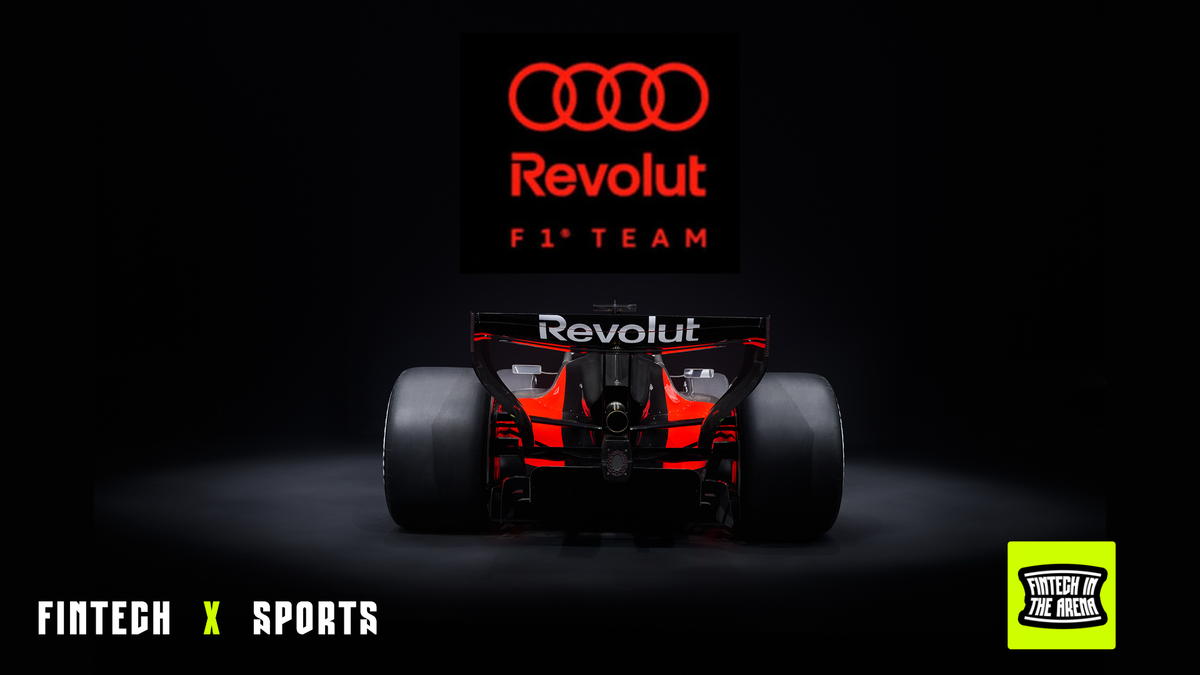
Not every basketball partnership reaches the end of that chain, nor does every company need it to.
Ledger may value the institutional visibility of appearing on an NBA jersey differently from Revolut, which can put NBA branding directly into a customer's wallet. Robinhood's three-team footprint serves a different purpose again as the company broadens its identity beyond retail trading. SoFi can use an NBA property to put a specific product in front of members at the exact moment fan attention peaks.
That is what makes the current financial presence in basketball worth watching.
The same sports inventory can perform very different jobs depending on the company buying it, the product sitting behind it and how far the partnership is allowed to travel into the customer experience.
The logo is still the most visible part of the deal. Increasingly, it is only the beginning of what the deal can do.
Basketball is only one piece of the puzzle.
The same themes are beginning to emerge across football, Formula One, motorsport and other major sports properties. We follow those developments through original research, weekly reporting and long-form analysis.
Subscribe to FinTech in the Arena to stay ahead of the deals - and the strategies behind them.
Comments ()