How Colombia's World Cup Return Became a Fintech Moment
Eight years after missing the World Cup, Colombia is back - and so is the commercial machine surrounding Los Cafeteros. Beneath the celebrations lies a story of how banks, super-apps, and telecom giants are competing to shape the future of money for 52 million Colombians.
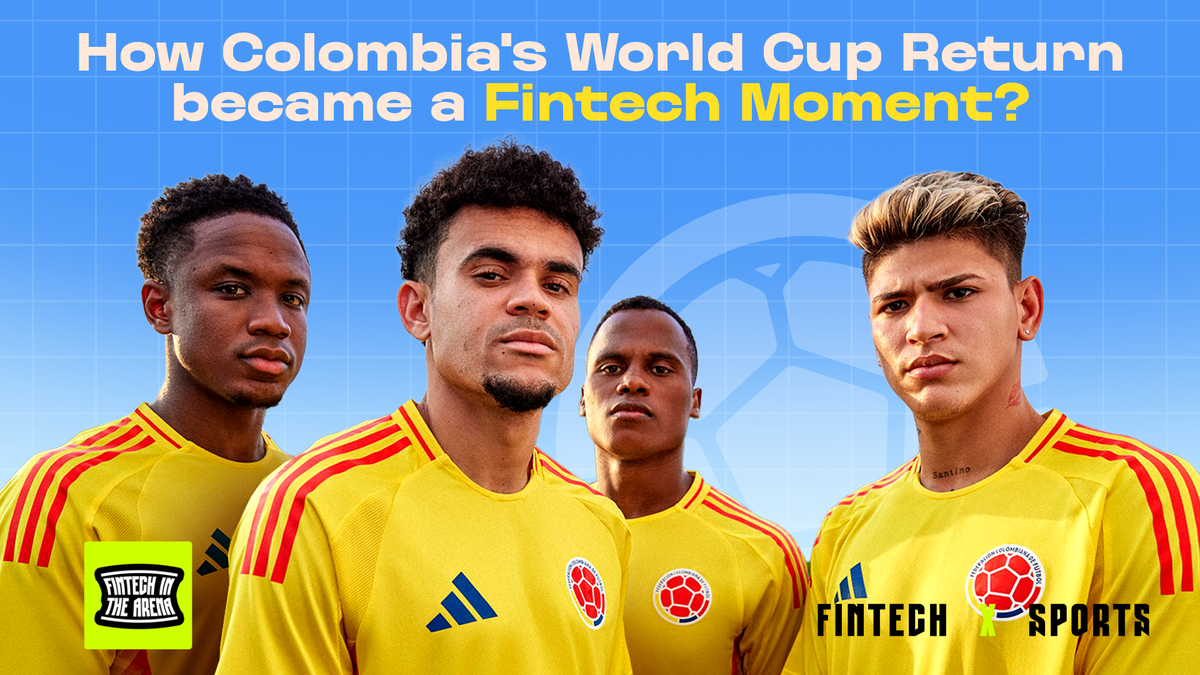
How Rappi, Nequi, Bancolombia, and a telecom giant are riding Colombia's World Cup return to reshape how 52 million people move money
Eight years is a long time to wait. When Colombia failed to qualify for the 2022 World Cup in Qatar - finishing sixth in the CONMEBOL table, eliminated by a single point - the commercial silence that followed was deafening. Sponsors recalibrated. Activations were shelved. The yellow jersey, one of the most recognisable strips in South American football, disappeared from the world's biggest stage.
The 2026 FIFA World Cup has changed all of that in one group-stage afternoon. Colombia opened their campaign in Group K with a 3–1 win over Uzbekistan at the Azteca Stadium, with Luis Díaz orchestrating an assist before sealing the result himself. Los Cafeteros are back, the country has exhaled, and the commercial machine behind the Federación Colombiana de Fútbol (FCF) is running at full velocity.
For fintech operators studying Latin America, Colombia's 2026 World Cup cycle offers something rare: a market where pent-up national emotion, rapid digital financial adoption, and a reconfigured commercial roster are all moving in the same direction at the same time.
The Commercial Roster, Read Through a Fintech Lens
The FCF's active partner ecosystem for 2026 reflects the broader shift happening across Colombian financial services - away from branch-first banking toward mobile-first access. Two partnerships anchor the fintech layer of the federation's commercial roster.
Bancolombia has now spent ten consecutive years as the official bank of the national team. In 2026, that relationship has evolved significantly in how it presents itself publicly. The activation strategy this cycle centres on Nequi - Bancolombia's neo-bank spin-off - and the bank's digital payment processing infrastructure rather than traditional branch-based services. The World Cup provides Bancolombia with an audience of millions of younger, mobile-first fans, precisely the demographic that Nequi was built to serve. When Colombia plays, Bancolombia's commercial goal is to convert the emotional spike of a national football moment into a Nequi account opening or a first digital transaction.
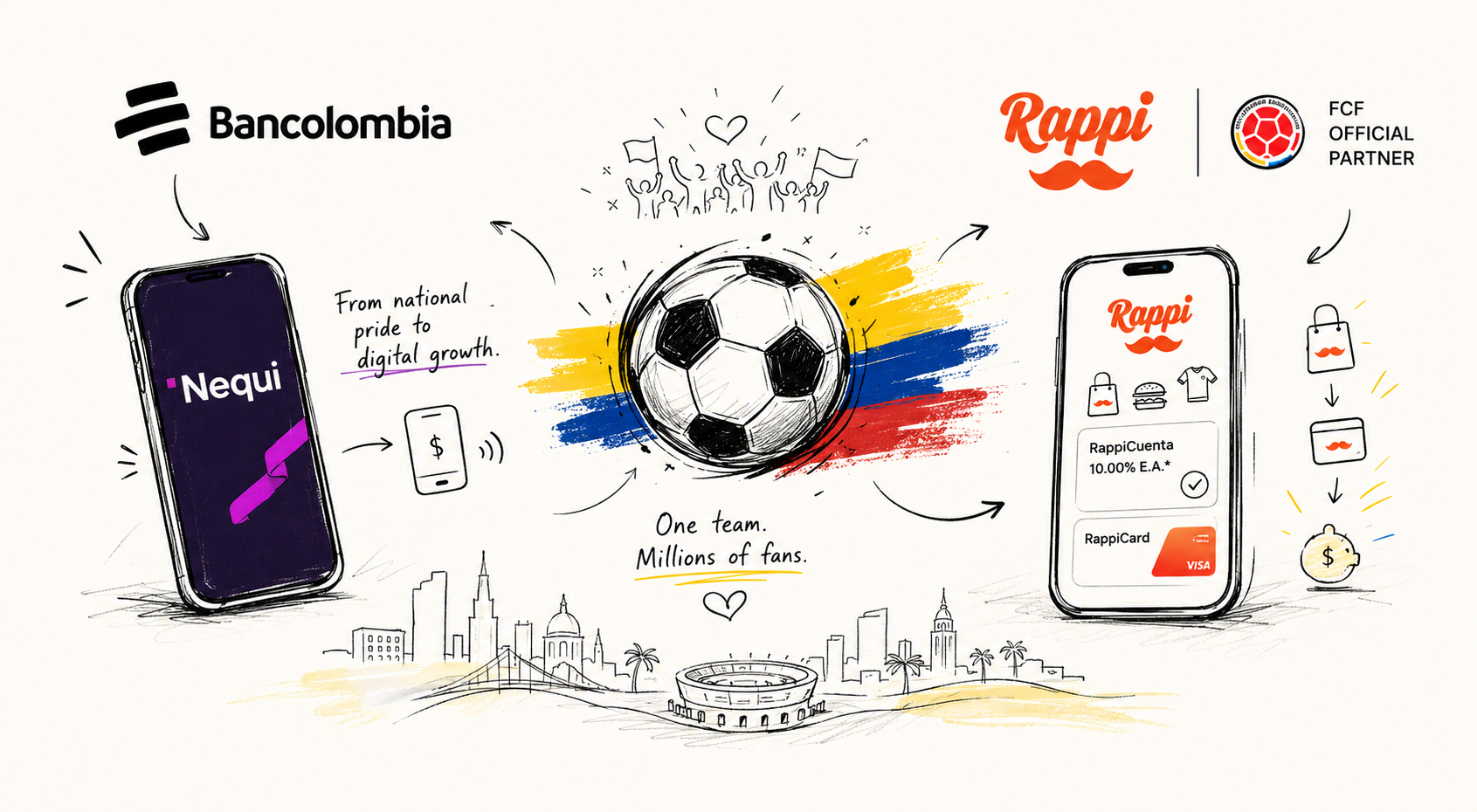
Rappi operates at the other end of the commercial relationship. Colombia's dominant super-app - which began as a delivery platform and has since built RappiPay into a fully functional fintech arm - holds official partner status with the FCF. The structural logic of that deal is worth examining carefully: Rappi uses the national team relationship to move fans through its ecosystem, from food and merchandise orders during match days toward adoption of RappiCuenta (its high-yield digital savings account) and the RappiCard. On match days, when La Fiebre Amarilla takes hold and transaction volumes spike in the hours before kickoff, Rappi sits at the centre of how Colombians spend. That is a distribution play built on a branding foundation.
The 2026 Structural Change: Claro Pay and the Telco-Fintech Convergence
The most significant commercial development in the FCF's 2026 roster has nothing to do with a traditional fintech company. In March 2026, the federation announced a new principal sponsorship agreement with Claro - the Colombian arm of Carlos Slim's América Móvil group - replacing Movistar as the federation's primary telecom partner.
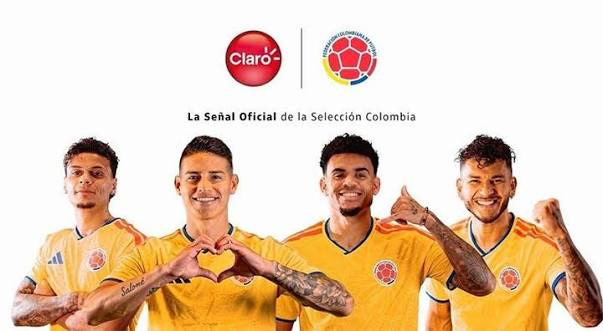
On the surface, this reads as a standard telecom deal. The fintech dimension runs deeper. Claro operates two relevant financial products:
- Claro Pay - a standalone digital wallet for transfers, low-value deposits, and utility payments, available to millions of Colombian SIM card holders
- Mi Claro - a super-app built in partnership with Alipay+, designed to embed payment rails directly into Claro's existing mobile network infrastructure
What Claro is doing in Colombia fits a pattern playing out across Latin America: large telecom operators using their subscriber base as a distribution network for financial services, competing directly with neo-banks for the financially underserved population. Claro enters a household with a SIM card and a phone contract. Claro Pay turns that relationship into a financial one. The FCF sponsorship is the visibility layer that builds consumer trust in Claro Pay as something beyond a billing utility - it positions the wallet alongside the national team, inside the country's most emotionally charged commercial moment.
For researchers tracking embedded finance across the region, this deal belongs in the same analytical frame as Vodacom M-Pesa in East Africa or Telkomsel's financial services push in Southeast Asia. The infrastructure already exists; what the football partnership provides is cultural legitimacy.
Global Rails Underneath the Local Ecosystem
Colombia's domestic fintech partners operate within a global payment infrastructure that shapes how they can activate during the tournament:
- Visa holds official FIFA partner status for payment technologies across all 2026 World Cup venues
- Mastercard holds the financial services rights for CONMEBOL (the continental governing body for association football in South America) through 2026
Both card networks set the framework within which companies like RappiPay must build their consumer campaigns. RappiPay's fan activations - cashback offers, in-app tournament promotions, exclusive merchandise purchasing - are built on top of card rails that Visa and Mastercard control at the infrastructure level. Local fintech innovation operates within that architecture rather than around it.
The Redemption Economy
Colombia's absence from the 2022 tournament created something that rarely appears in commercial data: suppressed demand. Eight years without a World Cup appearance, followed by a triumphant return with a squad built around the explosive Luis Díaz, has produced a consumer moment that fintechs are actively pricing into their activation budgets.
La Fiebre Amarilla - the yellow fever, as Colombians call the collective obsession with the national team - translates directly into measurable commercial behaviour. On the day Colombia played their opening Group K fixture, transaction volumes through apps like Rappi spiked in the hours before kickoff as fans ordered food, purchased merchandise, and topped up digital wallets. The yellow Adidas jersey functions as both cultural uniform and commercial catalyst, with fintechs offering BNPL schemes and cashback incentives specifically tied to kit purchases ahead of each fixture.
The key commercial faces of this cycle:
- Luis Díaz ("Lucho") - the undisputed face of Colombian football in 2026. His performance in the opening match - the assist, the goal, the way he orchestrated Colombia's attacking dominance - makes him the commercial anchor for any fintech building a Colombian activation strategy around this tournament
- James Rodríguez - still carries nostalgic equity among older millennials, holdovers from the golden generation of the 2014 World Cup
- Linda Caicedo - represents the women's national team frontier, an audience that skews young and digital-native, exactly the demographic neo-banks are competing hardest to acquire
What This Ecosystem Signals
Colombia's 2026 commercial partner roster is a snapshot of three distinct models operating in parallel:
- Bancolombia / Nequi - the incumbent institution using football to drive digital product adoption; the legacy player making a credible pivot to mobile-first banking
- Rappi / RappiPay - the super-app model, where an ecosystem company uses a sports relationship to pull users up the value chain from transactions into financial products
- Claro / Claro Pay - the telco-fintech convergence, where infrastructure scale becomes the distribution advantage that traditional fintech startups have to raise hundreds of millions of dollars to build from scratch
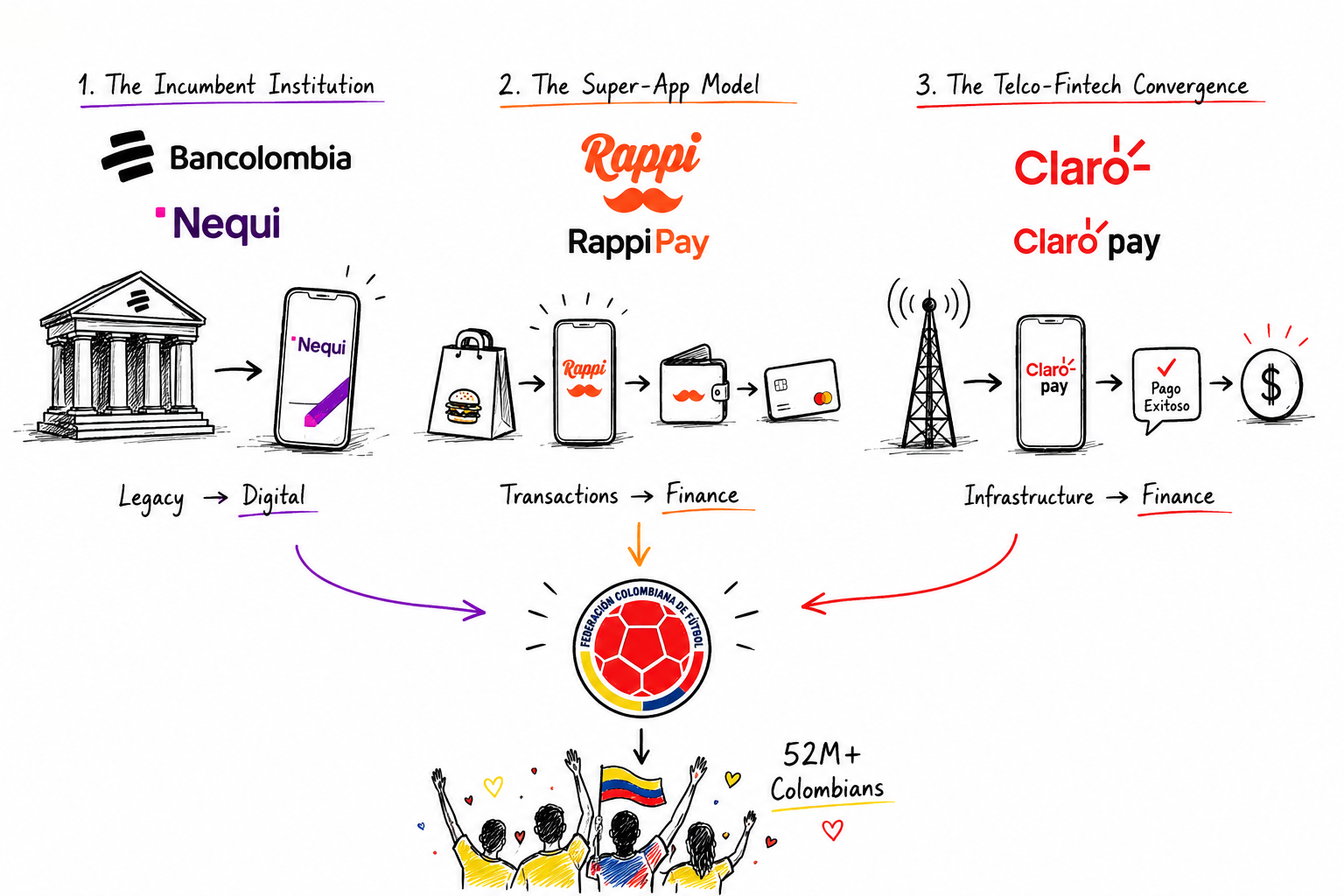
All three are using the same national team to do different things. That is what makes Colombia's 2026 ecosystem worth studying as a standalone case: one football federation, three distinct theories of how financial services adoption happens in a market of 52 million people, and a World Cup return that has given all three partners the cultural moment they needed to make their case to the consumer.
Los Cafeteros are back on the world stage. The fintechs sponsoring their return have been waiting for this as long as the fans have.
The series continues. Every deal, every country, every angle.
Marcel van Oost has spent eight years connecting the dots across fintech partnerships, capital flows, and commercial strategy through Connecting the Dots in FinTech - one of Europe's most-read fintech intelligence newsletters with 130,000+ subscribers.
Comments ()