All In on Argentina
As Lionel Messi takes the pitch for his final World Cup, we breakdown the infrastructure plays of Ant International, Nexo, LuLu, and Kalshi - and why the Argentine crest has become the ultimate trust signal for global fintech scaling.
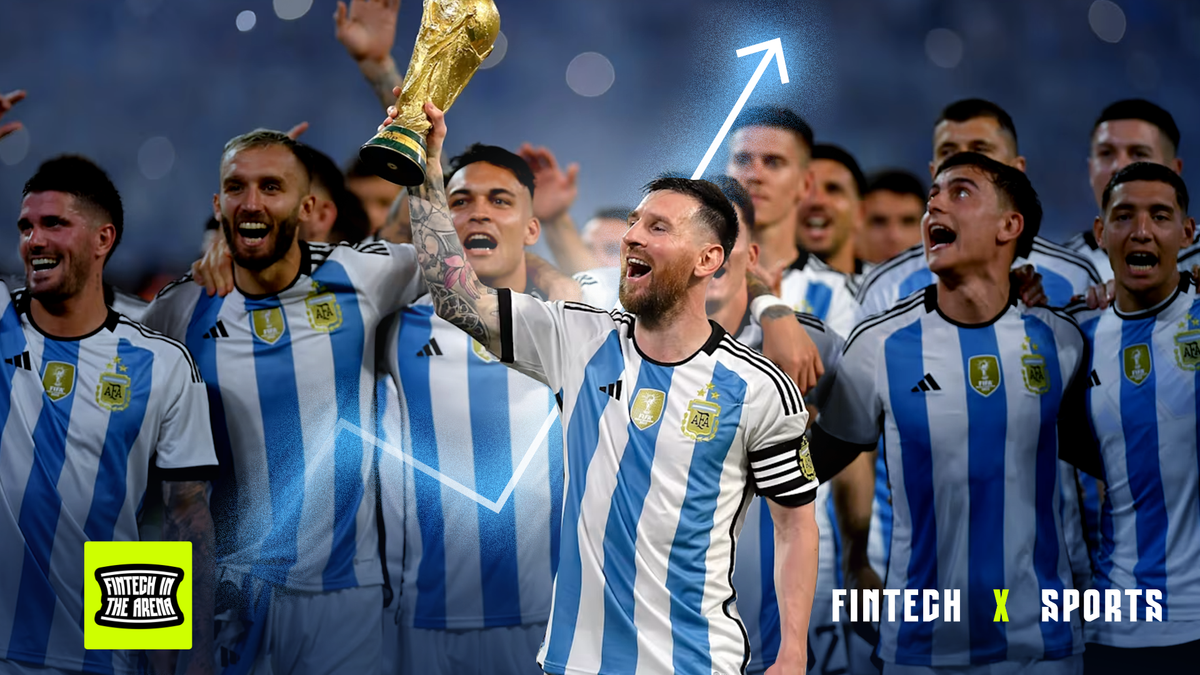
The Fintech Stack Behind the World's Most Emotional Football Team
48 nations. 104 matches. 3 host countries. The 2026 FIFA World Cup is the largest football tournament ever staged, and the most commercially loaded. Across the coming weeks, this series - Fintech on the Pitch - decodes every significant FinTech X Sport deal at this tournament, country by country. What was signed, what was built, and what it signals for the industry.
Argentina goes first. It always does. ⚽
A Country That Doesn't Do Football Quietly
In December 2022, when the final whistle blew in Lusail and Argentina were world champions for the third time, an estimated five million people flooded the streets of Buenos Aires. The Obelisco disappeared inside a sea of blue and white. Military aircraft flew in formation overhead. The squad's bus moved roughly 500 metres in four hours before the players were airlifted by helicopter because the crowd made forward movement physically impossible - one of the largest spontaneous human gatherings ever recorded in a single city.
That is the country 4 fintech companies decided to put their names next to.
The emotional temperature around Argentine football has not cooled since Qatar. Lionel Messi will be 38 years old when this tournament kicks off. The football world understands what that means. This is his last World Cup, and the farewell is built into the commercial value of every partnership announced, every activation planned, every broadcast minute that follows Argentina through the tournament. When Messi's photograph lifting the trophy became the most liked post in Instagram history - over 75 million likes, a record that still stands - he stopped being merely a footballer and became a global cultural figure whose association carries weight in markets far beyond South America.
That reach extends deep into Asia. Messi's commercial relationships across China, Japan, South Korea and Southeast Asia span over a decade. For a company whose business model depends on connecting Asian digital payment infrastructure to global merchant networks, the Argentine shirt is not just football. It is a bridge between cultures, consumers, and commerce.
And then there are the cyclists. Three Argentine fans rode 11,000 miles across 16 countries just to be in the same country as Messi during this tournament. New York Post documented their journey. Any fintech CMO reading that should be running one calculation: what does it cost to reach an audience that emotionally engaged through any other channel?
The answer, across digital advertising benchmarks, is brutal. FIFA's own broadcast figures put the 2022 World Cup cumulative audience at five billion across all matches. Reaching even a fraction of that through paid media runs into hundreds of millions of dollars. Brands attached to the Argentine shirt during Qatar did not buy an audience; they inherited one that no media budget could have assembled independently. 4 fintech companies have decided the 2026 version of that inheritance is worth having.
The Deals - Four Fintechs, One Shirt
Argentina's financial services sponsorship stack for 2026 is unlike any other nation at this tournament. Four distinct fintech companies, four different commercial theses, all sitting next to the same crest. Understanding why requires understanding what the 2022 World Cup did to AFA's commercial position - and what Leandro Petersen, AFA's chief commercial and marketing officer, has built since.
"Each new alliance of this caliber reinforces that the path we charted for AFA's international expansion is the right one," Petersen said when announcing the most recent partnership in the stack, "and that the world's leading organisations want to be part of it."
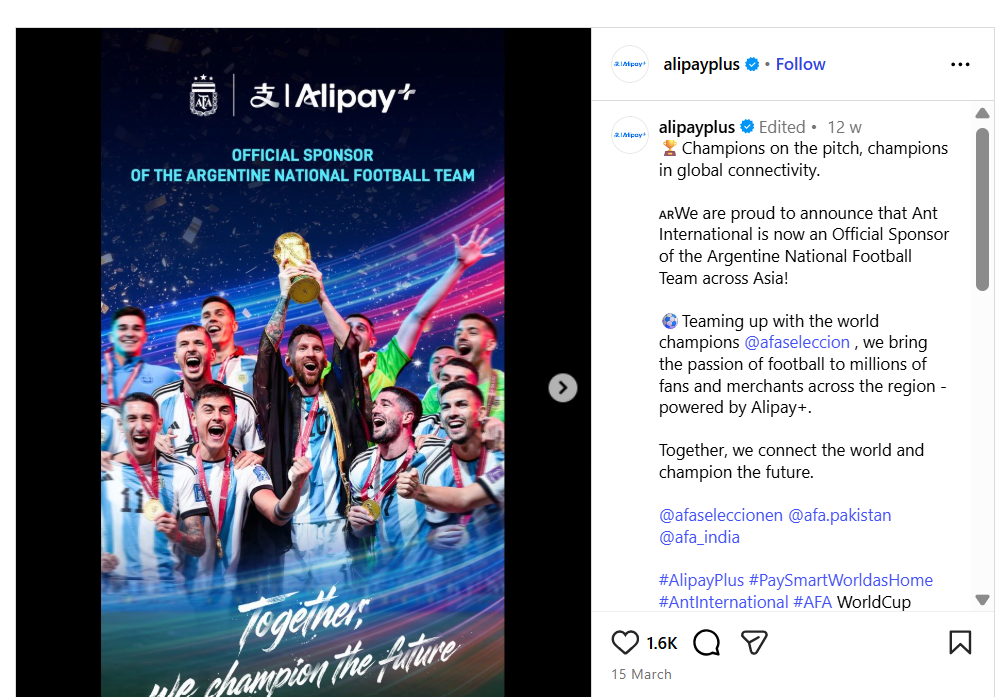
Deal 1 - Ant International / Alipay+
Ant International is the global operations arm of Ant Group, the Chinese fintech giant that grew out of Alibaba's payment infrastructure. Its consumer-facing product, Alipay+, connects 1.8 billion consumer accounts to more than 150 million merchants across Asia Pacific, integrating over 300 payment methods into a single acceptance layer. That number is the entire commercial logic behind the AFA deal.
Sport is not a new territory for Ant. In September 2025, Alipay+ became an Official Payment Partner of the Laver Cup through 2029, embedding payment infrastructure into one of tennis's fastest-growing international properties. The Argentine national team deal extends that playbook from tennis to football, and from a single annual event to the most-watched sporting tournament on the planet.
→ The activation logic is geographic as much as it is cultural. The United States, Canada, and Mexico - the three host nations - collectively carry significant Asian tourist and diaspora populations, all of whom will travel in substantial numbers during June and July. Alipay+ needs merchant acceptance and consumer trust in markets where its wallet network is underrepresented. Argentine football, playing in those same cities, provides the cultural introduction that cold merchant acquisition never could.
Peng Yang, CEO of Ant International, was direct: "Sports and tech are two critical bonds for communities and markets that break barriers and connect people. Together we will bring more extensive and enriched football experience and community impact through our Asia fintech and digital services network."
The shirt is the trust signal. The payment rails are what Ant is actually building.
Deal 2 - LuLu Financial Holdings (LuLu Exchange + Digit9)

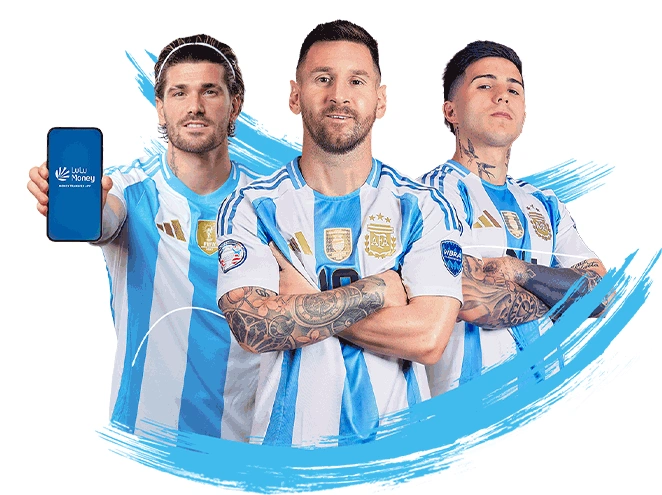
The partnership announcement happened in Dubai on July 22, 2025, with Argentina's World Cup-winning coach Lionel Scaloni present alongside senior LuLu Financial Holdings leadership and AFA executives. The geography of that launch tells you everything about what this deal is actually buying.
This is a group-level agreement. LuLu Financial Holdings - the parent company operating across 10 countries - has structured the AFA partnership so that different entities within the group activate it as regional fintech partners within their respective markets. LuLu Exchange operates the remittance and foreign exchange layer. Digit9, another entity within the group, activates as a separate regional partner. One football shirt, one parent company, multiple fintech products reaching different diaspora communities across different geographies simultaneously.
→ The commercial thesis is unusually transparent in LuLu's own framing: "Football and remittances might seem like worlds apart, but at their core, they both demand the same thing: getting it right when it matters most." A parent paying school fees, a son supporting his family, a friend sending help in an emergency - the LuLu Money App activation is built entirely around converting football emotion into remittance transactions. Fan rewards, match tickets, in-app surprises tied to tournament moments all feed back into the same funnel.
Where Alipay+ is building payment infrastructure for Asian travellers heading to North American tournament venues, LuLu Financial Holdings is activating around an entirely different cross-border money corridor - the South Asian and Middle Eastern diaspora communities for whom Argentine football is a shared cultural touchpoint and for whom remittance is a weekly reality. Same shirt. Completely different payment flow. The group structure lets them do it at scale across multiple markets with a single sponsorship agreement.
Deal 3 - Nexo

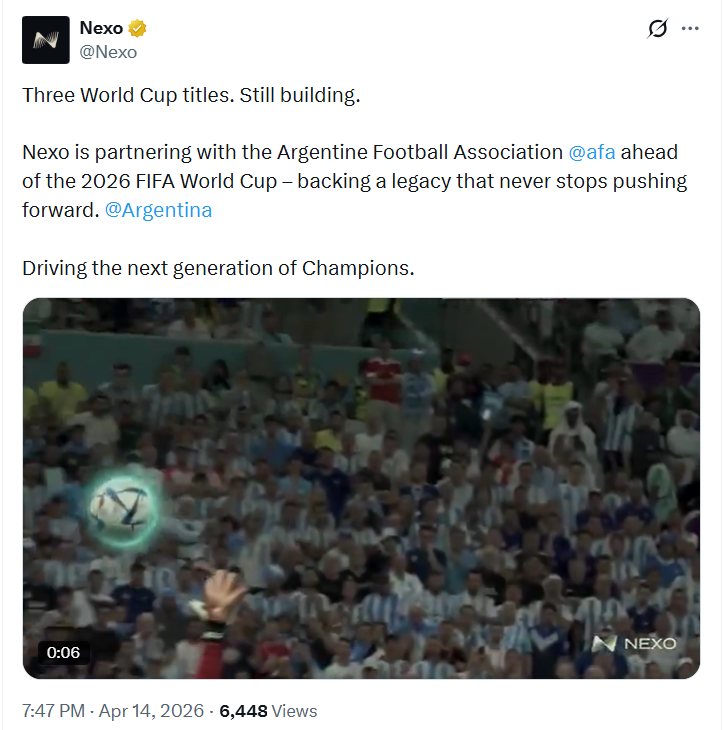
Sport is not a new territory for Nexo either. The company has built a deliberate premium sport portfolio - Official Crypto Partner of the Australian Open and Summer of Tennis, Official Digital Wealth Platform of the DP World Tour, Official Partner of the Audi Revolut Formula 1 Team. Tennis, golf, Formula 1 - and now the world's most watched football team. The Argentine deal is the largest and most culturally loaded in that portfolio by some distance, and the progression follows a clear internal logic: each property is more globally watched than the last.
Nexo operates a digital asset platform built around crypto-backed lending, yield products, trading, and institutional wealth solutions - serving over seven million users globally, managing more than $11 billion in assets, and having processed upwards of $320 billion in transactions since founding.
→ To understand why Argentina specifically, it helps to understand what has happened to the Argentine peso. The currency lost over 50% of its value in 2023 alone. Inflation has been a structural feature of Argentine economic life for decades, and ordinary people - salaried workers trying to protect savings - turned to dollar-pegged stablecoins and digital assets as a practical response long before crypto became a global conversation. Chainalysis has consistently ranked Argentina among the top countries globally for grassroots crypto adoption, driven entirely by economic necessity. This is a population that already understands what digital assets are for.
Nexo had already committed to that market before the AFA deal. The company operates Buenbit by Nexo, a local digital asset platform serving Argentine and broader LATAM retail users. The World Cup partnership is an amplification of an existing regional presence.
Federico Ogue, CEO of Buenbit by Nexo, put it directly: "Argentina's national team represents the highest level of sporting excellence, built on talent, conviction, and an unrelenting will to win. At Nexo, we share that standard. As we grow our presence in Argentina and across South America, partnering with AFA is a statement of commitment to this region and the clients we serve here."
The Nexo-AFA deal is, at its core, a branding story - and a carefully constructed one. Crypto lending as a category carries a trust deficit that the 2022 market events deepened considerably. FTX collapsed. Celsius froze withdrawals. The broader unravelling of overleveraged digital asset platforms made consumers and regulators substantially more cautious across the entire category. Nexo navigated that period without the same fate, but the trust challenge did not stay with the companies that fell - it spread across the industry. Association with an institution carrying 130 years of football history, the world's most famous active footballer, and a fanbase that spans every continent does work that performance marketing cannot replicate.
Deal 4 - Kalshi

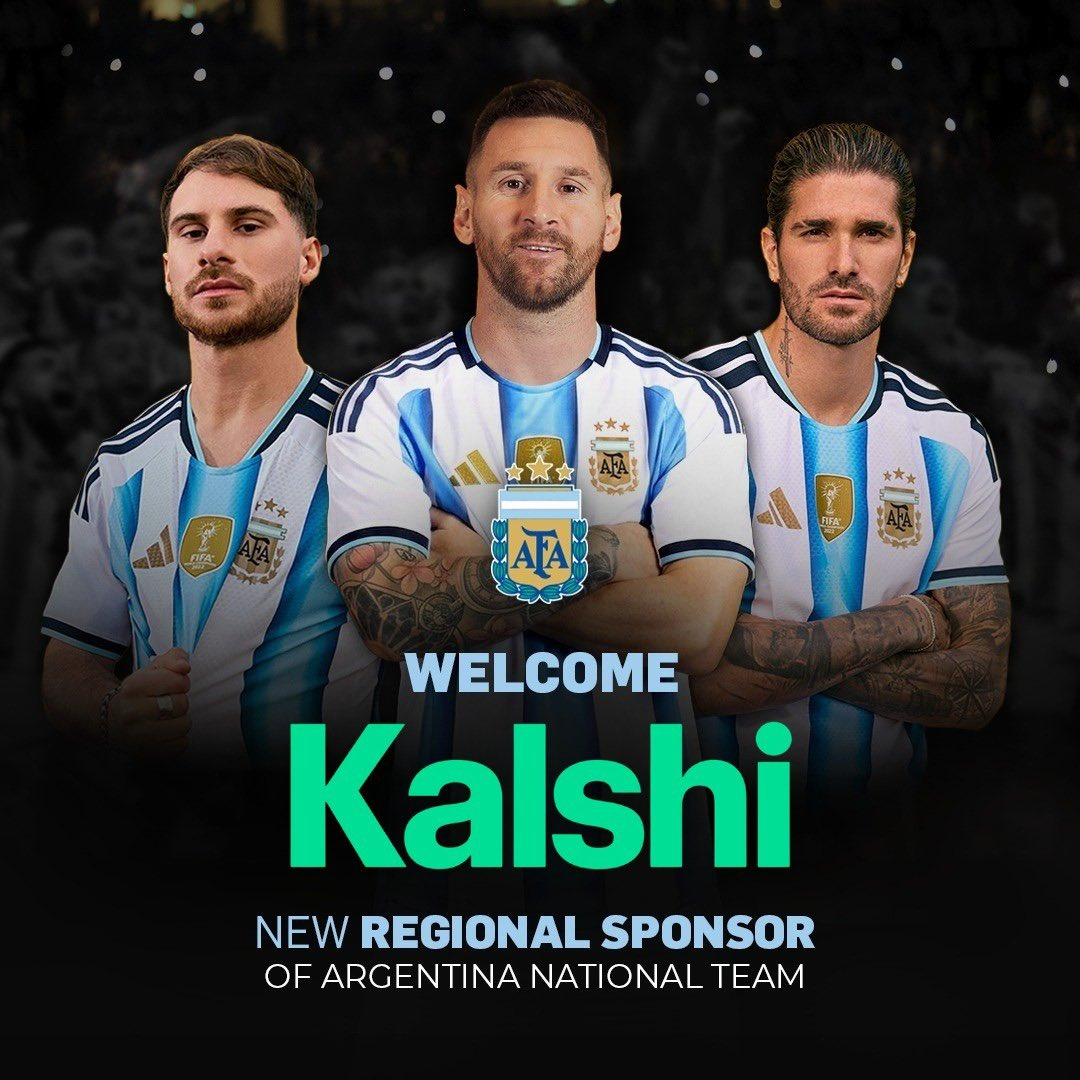
Kalshi is the leading regulated prediction markets platform in the United States - a category that has moved from a legal grey area to a mainstream commercial product following recent regulatory changes that finally allowed prediction markets to operate openly in the US. The AFA partnership gives Kalshi co-branded activation rights, coordinated social media campaigns, and use of AFA intellectual property across its marketing materials. Genius Sports, AFA's official data and streaming partner, will provide Kalshi with official sports data to support the creation and settlement of prediction market contracts - and Kalshi will participate in Genius Sports' integrity information-sharing processes.
That last detail matters.
Kalshi is not only buying a badge. It is embedding itself into the official data infrastructure of the Argentine national team's World Cup campaign, which gives the partnership operational depth beyond what most sponsorship deals carry.
Adam Barrick, head of sports partnerships at Kalshi, was explicit about the positioning: "Argentina is the standard of excellence in world football. That's exactly who Kalshi belongs alongside. We're building the future of how people engage with live events, and partnering with the reigning champions of the beautiful game is the clearest signal we can send about where we're headed."
→ Prediction markets need two things simultaneously right now: awareness among a mainstream audience that has never used one, and legitimacy signals that tell that audience this is a regulated, serious product. The Argentine national team, with its global reach and institutional standing, delivers both in the same partnership. This is a branding play - but one with a specific job to do in a specific regulatory and cultural moment.
If You're a Fintech CMO Reading This
Most fintech companies sign the sport sponsorship deal before they have answered the question. They buy the badge because the property is exciting, because a competitor moved first, because someone in a boardroom decided they needed to be in football. The activation follows the signature rather than driving it, and eighteen months later the CMO is explaining to the CFO why the numbers do not reflect the investment.
Argentina's stack in 2026 is instructive precisely because none of these four partnerships look like that. Ant had a geographic thesis before they signed. Nexo had a regional presence before they amplified it. LuLu had a community before they activated it. Kalshi had a regulatory moment before they announced it. In each case, the partnership was the final piece of a strategy that already existed - not the beginning of one still being figured out.
That is the discipline that separates Fintech X Sport partnerships that return value from the ones that just look good in a press release.
And it's exactly the lens we'll continue applying across every market, sponsorship and strategy in this series.
The series continues. Every deal, every country, every angle.
Marcel van Oost has spent eight years connecting the dots across fintech partnerships, capital flows, and commercial strategy through Connecting the Dots in FinTech - one of Europe's most-read fintech intelligence newsletters with 130,000+ subscribers.
Comments ()